Which fake websites a removal service can take down, when to report one yourself for free, and the red flags of removal offers that are scams themselves.
Quick answer: A fake website removal service reports fraudulent sites to the companies that can disable them, such as hosting providers, domain registrars, browser blocklists, search engines and ad platforms, and follows up until the sites are offline. Brands hire these services to remove sites that impersonate them. If you are a consumer who found a fake site or lost money to one, you can report it yourself for free, and you should be wary of anyone who charges you to remove it or promises to get your money back.
This article explains which kinds of fake websites can realistically be removed, who actually needs a paid service, and how to tell a legitimate provider from the removal scams that target people who have just been defrauded. For what happens inside a single takedown, see the phishing site takedown process, step by step.
Which fake websites can be removed
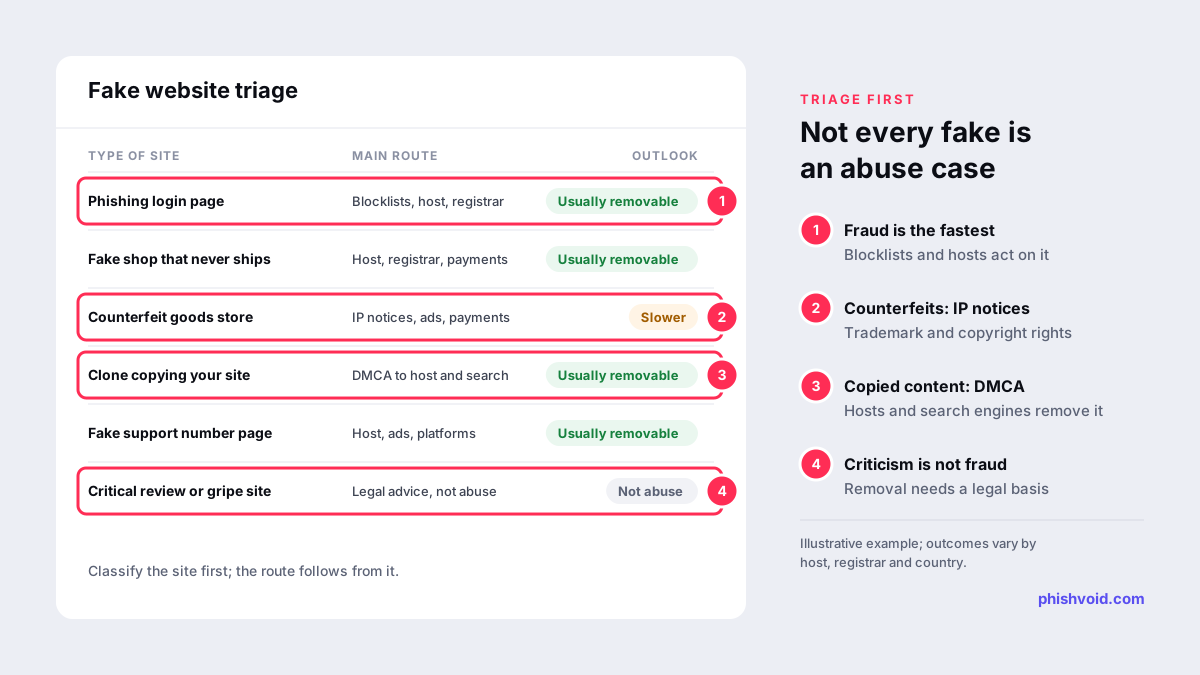
Removal depends on what the site does, because each type breaks a different rule, and each rule has its own enforcement route.
| Type of fake site | What it breaks | Main removal route | Realistic outlook |
|---|---|---|---|
| Phishing page copying a login or payment form | Fraud; DNS abuse | Blocklists, host, registrar | Usually removable; browser warnings often come first |
| Fake shop that takes payment and ships nothing | Fraud | Host, registrar, payment provider, blocklists | Usually removable with evidence of fraud |
| Store selling counterfeit branded goods | Trademark and copyright | IP notices, ad platforms, payment programs, UDRP | Slower; see counterfeit website takedown |
| Clone that copies your site's text and images | Copyright | DMCA notice to host and search engines | Often removable |
| Fake customer support or investment page | Fraud | Host, registrar, ad and social platforms | Usually removable |
| Site criticizing a company or collecting complaints | Usually nothing | Legal advice, not abuse reporting | Generally not removable through abuse channels |
The last row matters. A site that is unpleasant about your company is not a fake website unless it pretends to be you or breaks a law. Abuse desks will not remove it, and a provider that claims otherwise is either misleading you or planning to misuse a process meant for fraud. For copied content, our guide to DMCA notices against cloned websites explains when that route works.
What a removal service adds to a single report
Anyone can report a fake website. A service is worth paying for when the reporting is only part of the work:
- Evidence before the site changes. Fake sites often show different content to different visitors, or vanish and return. A service captures them in a form that abuse teams accept.
- Every layer at once. Blocklists, host, registrar, CDN, ad platforms and, for shops, payment providers are contacted in parallel rather than one by one.
- Follow-up. Automated replies, partial removals and providers that never answer need chasing and escalation.
- The next copy. Fraud operators reuse the same site on new domains. Recognizing it quickly turns a new incident into a routine report.
Do you need a service? Brands and individuals
The answer depends on which side of the fake site you are on.
- Brands facing recurring fakes, several channels or customers in many countries are the natural customers. Here the question is not whether to remove the sites, but whether your team has the time and contacts to do it consistently.
- Individuals who came across a fake site usually do not need to pay anyone. Reporting it to a browser blocklist and the host takes a few minutes, and our guide on how to report a scam website walks through each step.
- Victims who entered details or paid money should act on their accounts first. Removing the site will not bring money back; call your bank or card issuer straight away. Our I got phished page lists the first steps.
Red flags: removal offers that are scams
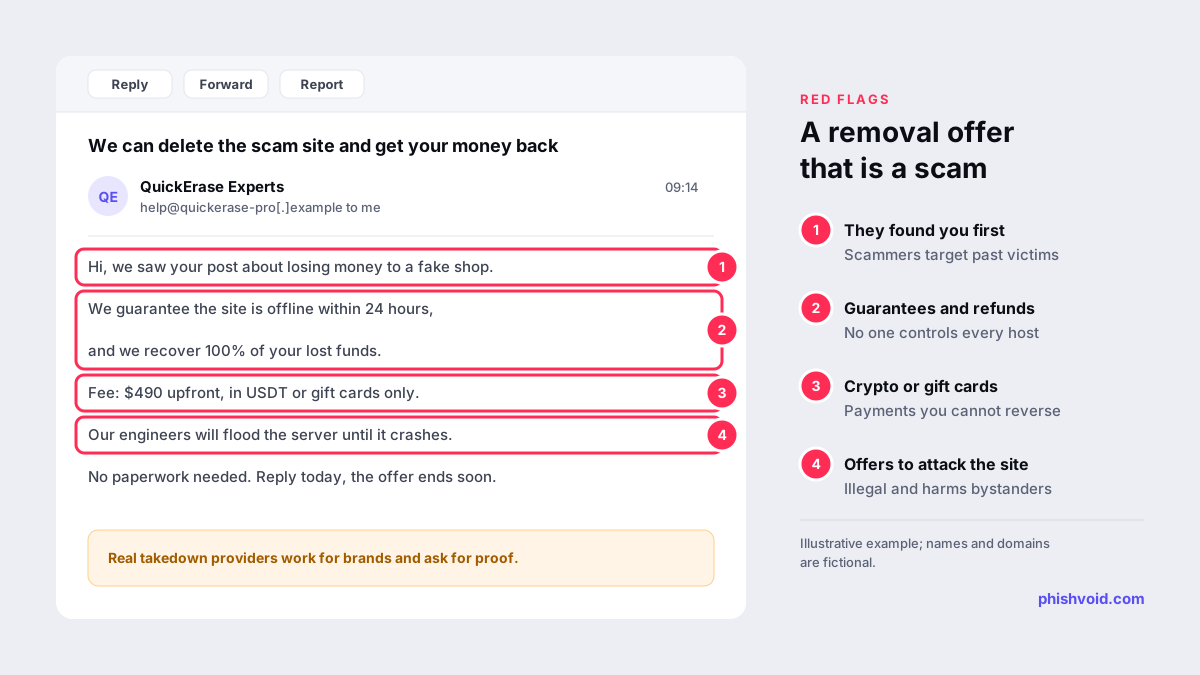
People who have just lost money are a target in their own right. The US Federal Trade Commission warns that refund and recovery scammers contact people who were already defrauded, promise to recover their money and ask for a fee upfront (FTC). Offers to remove a fake website are a common wrapper for the same trick. Be suspicious of any provider that:
- contacts you first, often right after you posted about being scammed;
- guarantees removal within a fixed number of hours, regardless of host or country;
- promises to recover your lost money as part of the removal;
- asks for payment upfront in cryptocurrency, gift cards or by wire transfer;
- offers to hack, flood or otherwise attack the site, which is illegal and can harm unrelated sites on the same server;
- never asks who you are or whether you are entitled to act for the brand.
A legitimate takedown provider works through official channels, explains that results depend on third parties, and asks a brand to prove its authority before acting in its name.
How to choose a legitimate provider
If you are a brand comparing providers, a few questions separate real services from the rest:
- Who verifies each site? A person should confirm that a site is fake before it is reported, so that partners and resellers are not reported by mistake.
- Which channels are covered? Blocklists, hosts and registrars at a minimum, plus the platforms where your fakes are advertised or shared.
- How is a case closed? Only when the content is gone or the domain no longer resolves, not when a report has been sent.
- What authorization do they need? Expect a request for a signed letter of authorization from your company.
- How are you charged? Per removal, by quota or by subscription. Our guide to choosing a phishing takedown service compares these models in more detail.
Phishvoid works only for brands that authorize it: a human team verifies each fake site, reports it to blocklists, hosts, registrars, CDNs, search engines and platforms, and follows up until it is down, under one subscription with unlimited takedowns.
FAQ
Can I pay someone to take down a fake website?
Brands can hire a takedown provider to act on their behalf. Individuals usually get the same effect by reporting the site to blocklists and the host for free. Be cautious of anyone who approaches you offering removal or money recovery for a fee.
How long does fake website removal take?
It depends on the type of site, the host, the registrar and the country. Phishing and outright fraud tend to move fastest, while counterfeit and copyright cases need more formal notices. Treat any fixed guarantee with suspicion.
Can a negative review site be removed as fake?
Not through abuse channels, unless it impersonates your company or breaks the law. If you believe content is defamatory, speak to a lawyer about the options in your country.
Will removing the fake site get my money back?
No. Removal stops new victims but does not reverse payments. Contact your bank or card issuer as soon as possible and report the fraud to the police or your national fraud reporting service.
Is someone impersonating your brand?
We find lookalike domains and cloned pages and take them down. Start with a free exposure scan.