A phishing takedown service finds, verifies and removes fake sites that copy your brand. Learn what it should include, how pricing works and what to expect.
Quick answer: A phishing takedown service finds websites that impersonate your organization, confirms they are malicious, gets them onto browser blocklists and asks the hosting provider, domain registrar and other services involved to remove them. A good service then follows up until the site is actually gone and watches for the same campaign returning on new domains. What you are buying is the time, contacts and persistence that removal takes.
This guide is for security, fraud and brand teams deciding whether to buy such a service and how to compare providers. If you want the mechanics of a single takedown from detection to confirmation, read the phishing site takedown process, step by step. Here the focus is on the service around those steps: scope, pricing models and realistic results.
What a phishing takedown service actually does
Behind the marketing, most providers sell some combination of four jobs:
- Detection: watching new domain registrations, certificate transparency logs, ads, social media and customer reports for pages that use your name, logo or login flow.
- Verification: confirming that a page is really malicious, not a reseller, a partner or a parked domain, and capturing evidence before it changes.
- Disruption: submitting the URL to blocklists such as Google Safe Browsing and Microsoft SmartScreen, so browsers warn visitors while removal is still pending.
- Removal and follow-up: sending abuse reports to the host, registrar, CDN and any other service involved, escalating when nobody answers and confirming the result.
Some vendors sell mainly the first job: a monitoring feed with a takedown button that costs extra. Others sell only the last: you find the sites, they remove them. Knowing which of these you are actually buying is the most useful question to settle early, because two offers with similar feature lists can lead to very different amounts of work for your team.
Managed service, platform or in-house?
There are three realistic ways to run phishing takedowns, and each suits a different kind of organization.
| Model | Who does the work | Usually suits |
|---|---|---|
| In-house | Your security or fraud team finds sites, writes abuse reports and chases replies. | Organizations with few incidents and staff who know the abuse ecosystem. |
| Self-serve platform | Software detects sites and pre-fills reports; your analysts review and send them. | Teams with analysts but little time for repetitive reporting. |
| Managed service | The provider's analysts verify, report, follow up and close each case under your authorization. | Brands with recurring attacks, several channels or no capacity for follow-up. |
Many organizations start in-house and switch when volume or follow-up becomes the bottleneck. The first 24 hours of a brand impersonation case show how much work a single incident creates. Multiply that by every new domain a campaign spins up, and the case for outside help becomes a question of capacity rather than skill. For a broader comparison of tools and managed services, see brand protection software vs managed service.
How to choose a phishing takedown service
Ask every provider on your shortlist the same questions, and ask for the answers in writing.
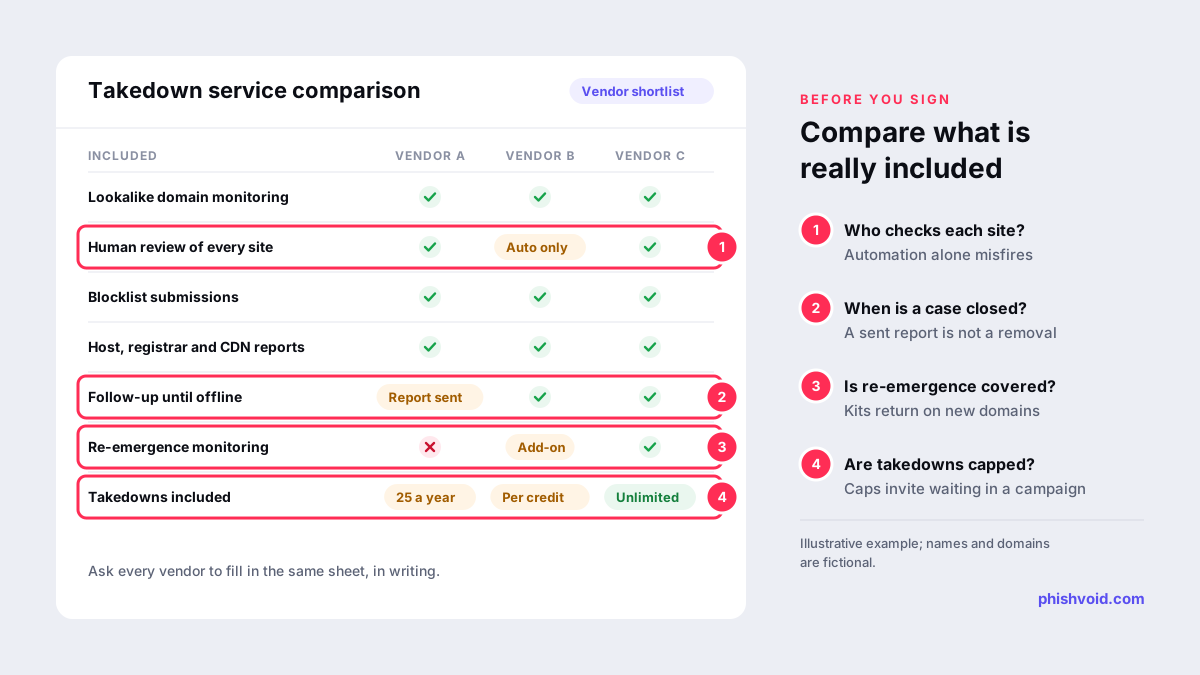
- Who verifies each site? Automated detection produces false positives. Reporting a legitimate partner or reseller can damage relationships and the provider's credibility with abuse desks. Ask whether a person reviews every case before a report goes out.
- Which parties do they contact? The minimum is blocklists, the host and the registrar. Check whether they also handle CDNs and reverse proxies, free hosting and site builders, URL shorteners, form back-ends, messaging bots used to collect stolen data, and national CERTs in the countries where your customers live.
- What counts as done? Some providers close a case when the report is sent. Ask for a definition based on the outcome: content removed or domain no longer resolving, checked from more than one location.
- What happens when a provider ignores the report? Escalation paths, upstream network providers and well-timed resubmissions are where experience shows.
- Are takedowns capped? Per-takedown pricing and annual quotas create a quiet incentive to wait. Ask what happens in a month with a large campaign.
- How do they prove authority? A legitimate provider acts only for brands that authorize it, usually through a signed letter of authorization, and should ask you for one before it starts.
- What will you see? Case-level evidence, timestamps for each step and an export you can share with legal, fraud and customer support teams.
Pricing models and what drives cost
Takedown pricing is rarely published, and the models differ more than the headline numbers. You will usually see one of three:
- Per takedown or per credit: predictable at low volume, but expensive and awkward during a campaign. Check whether a failed attempt or a redeployed site uses another credit.
- Tiered subscription: a monthly or annual fee that includes a set number of takedowns, brands or monitored domains.
- All-inclusive subscription: one fee with no takedown limit, usually priced on the size of the brand portfolio and the channels covered.
The factors that drive cost are similar everywhere: how many brands and domains are covered, which channels are monitored, whether human analysts verify and follow up, the languages and countries involved, and any reporting or integration needs. Phishvoid, for example, offers a single all-inclusive plan with unlimited takedowns and gives a quote after a demo rather than publishing a price list. Whichever model you consider, compare its cost with handling the same incidents yourself, including analyst hours and the fraud losses and support calls that each live site generates.
What results to expect
An honest provider will not promise a fixed removal time, because the outcome depends on organizations it does not control. Expect these patterns instead:
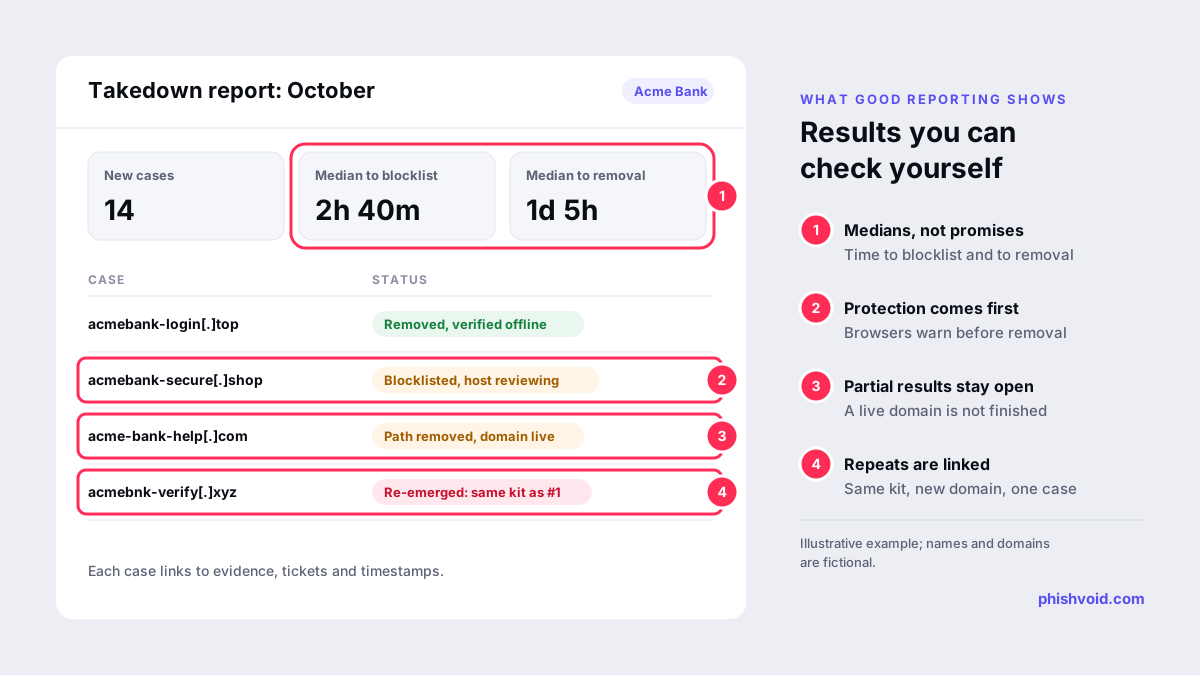
- Blocklisting comes first. A browser warning can appear well before the content disappears, and it often protects most potential victims.
- Response times vary by provider. Hosts and registrars with staffed abuse desks tend to act faster than small resellers or providers that ignore complaints. Since April 2024, ICANN's contracts require gTLD registrars and registries to act on well-evidenced phishing (ICANN), but country-code domains follow their own registries' rules.
- Partial results happen. A host may remove one path while the domain stays live, or a CDN may only forward the complaint. The case should stay open until the site is down.
- Campaigns come back. The same phishing kit often reappears on a new domain. A service that links new sites to earlier ones and treats them as one campaign saves time on every repeat.
Ask a prospective provider for anonymized case timelines and for the metrics it reports, such as median time to blocklist and median time to removal. A provider that measures its own work is easier to hold to account, and its numbers give you a baseline for later reviews.
What stays with your team
Even with a fully managed service, a few things remain yours: signing the authorization, naming a contact who can quickly confirm whether a domain or page is legitimate, telling customer support what to say when people report fakes, and making it easy for customers and staff to forward suspicious links. It also helps to know your own exposure before talking to vendors: which lookalike domains already exist and where your customers report fakes today.
Phishvoid works as a managed service: a human team verifies each site, reports it to blocklists, hosts, CDNs, registrars, search engines and platforms (and to USOM in Türkiye), and follows up until it is down. You can request a demo to see the case view and reporting before you decide.
FAQ
Is a phishing takedown service legal?
Yes, when it reports genuine abuse through the channels that hosts, registrars and blocklists provide, and acts only for brands that have authorized it. Avoid anyone who offers to knock a site offline by attacking it. That is illegal and can harm unrelated services that share the same server.
How fast can a phishing site be taken down?
It depends on the host, registrar and country involved. Blocklisting can follow quickly once a site is verified, while removal can take hours or much longer when a provider is slow to respond. Our guide on how long a phishing takedown takes covers the factors in detail.
Can a takedown service remove sites hosted in any country?
It can report sites anywhere, but results depend on the local provider and law. When removal stalls, blocklisting still limits the damage, because browser warnings do not depend on where the site is hosted.
Do we need a service if we only see a few phishing sites a year?
Perhaps not. A small number of incidents can be handled in-house with a clear process, good evidence and a list of abuse contacts. A service makes sense when volume, follow-up or monitoring becomes more than your team can carry.
Is someone impersonating your brand?
We find lookalike domains and cloned pages and take them down. Start with a free exposure scan.