Brand protection services find and remove fake sites, domains and accounts that use your brand. See what they cover, how pricing works and how to choose.
Quick answer: Brand protection services watch the internet for websites, domains, social accounts, ads and apps that misuse your brand, check which ones are actually harmful, and get them blocked and removed on your behalf. Good providers also follow up until each case is closed and keep watching for the same scam to come back. Before you sign, check four things: what they monitor, who verifies the findings, which channels they report to, and how the price is structured.
"Brand protection" is a broad label. It can mean trademark filing, counterfeit listings on marketplaces, grey-market resellers or phishing takedowns. This guide covers the online impersonation side: fake login pages, cloned stores, lookalike domains and fake support accounts that target your customers and staff. If you are still deciding between running a tool yourself and handing the work to a team, read brand protection software vs managed service alongside this one.
What brand protection services actually do
Most services in this space bundle the same six jobs. Providers differ in how much of each they do for you and how much they leave to your team.
- Detection. Watching new domain registrations and certificate logs for lookalike domains, scanning for pages that copy your logo or login form, and searching social platforms, ad libraries and app stores.
- Verification. Deciding which findings are real threats. A registered lookalike may be parked, owned by an unrelated business or held by your own marketing team. Someone has to look before anything is reported.
- Blocklisting. Submitting confirmed sites to Google Safe Browsing, Microsoft SmartScreen, Netcraft and the APWG so that browsers and security tools warn people before the page loads.
- Takedown. Sending evidence-backed notices to the hosting provider, the registrar, the CDN in front of the site, and the platform where a fake account or ad runs. Where a site copies your content, a DMCA notice can be another route.
- Follow-up. Re-checking each site, chasing providers that have not acted and escalating where they offer a path to do so.
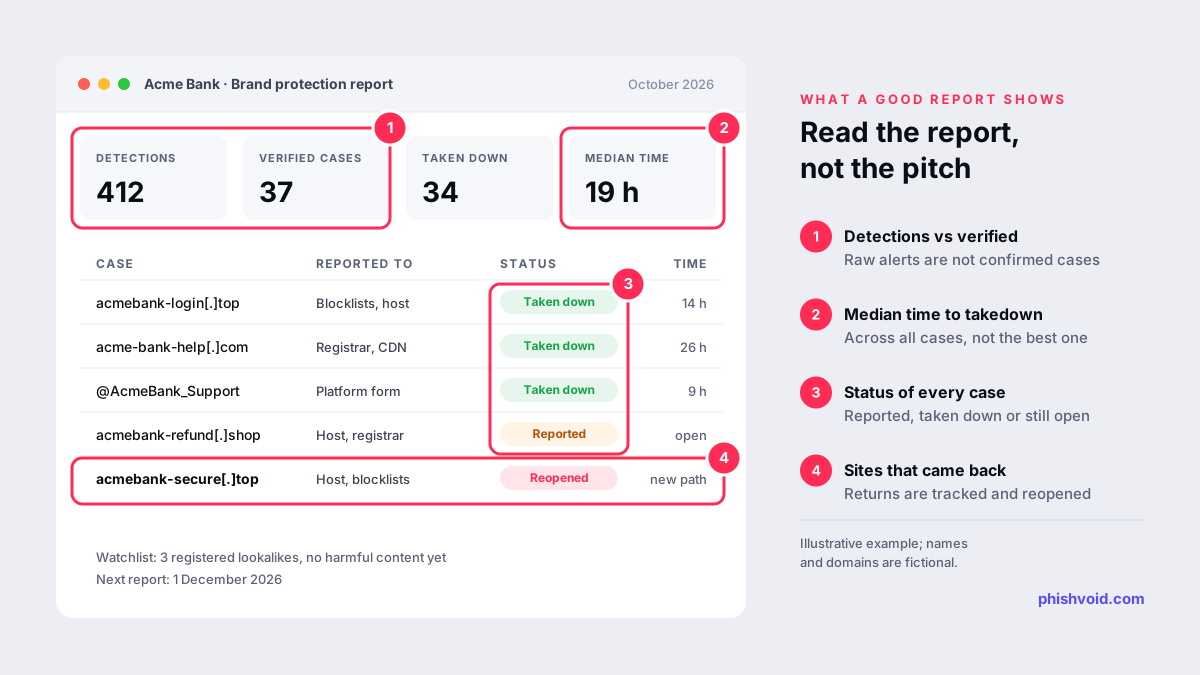
- Reporting. Showing you what was found, what was removed, how long it took and what came back.
The first and last items are easy to demonstrate in a sales call. The middle four are where the real work sits, and where providers differ most. Our step-by-step takedown process shows what each stage involves.
Who needs a brand protection service
It is tempting to assume only household names are targeted. The data says otherwise. In its report for the second quarter of 2026, the APWG identified 941 unique brands in phishing reports, and half of them were attacked five times or less in the quarter. Phishers build templates for regional banks, local retailers and niche software tools as well as global brands.
Signs that you have outgrown handling it ad hoc:
- Customers or staff forward fake sites or fake support accounts more than occasionally.
- Your support or fraud team spends time on account takeovers and refund requests that trace back to a fake page.
- The same scam keeps returning on new domains after you report it.
- You operate in several countries or languages and have no one watching local domains and platforms.
- Nobody owns the problem, so reports go out late or not at all.
If you see one fake site a year, you may not need a service yet. Our guide on how to report a scam website will get you through a single case.
How to choose a provider: what to check
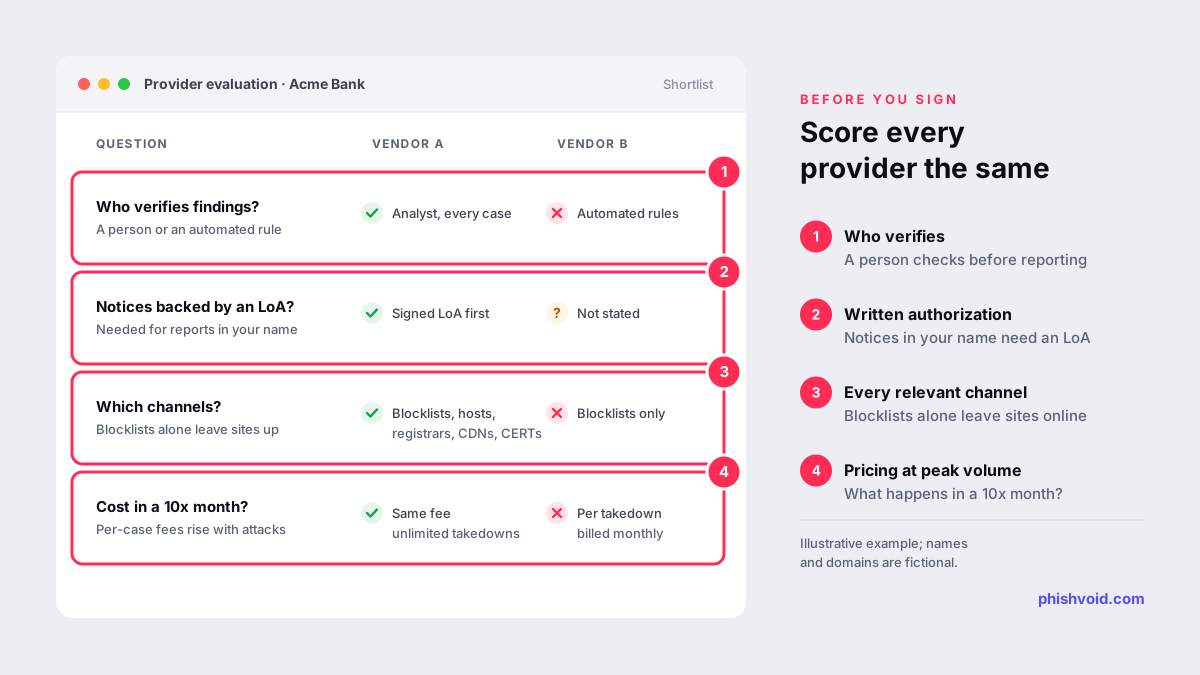
Ask every provider the same questions and ask for evidence, not adjectives.
- Coverage. Which channels do they monitor: domains, certificates, web content, social media, ads, app stores, messaging apps? Which do they only act on when you report them?
- Verification. Is every finding checked by a person before it is reported? Wrong reports harm innocent site owners and damage the provider's credibility with the hosts and registrars that act on them.
- Authorization. Notices in your name should be backed by a signed letter of authorization. A provider that skips this step is cutting a corner that hosts notice.
- Channels. Do they report to blocklists, hosts, registrars, CDNs, platforms, search engines and national CERTs, or only some of them? Blocklisting alone warns visitors but leaves the site online.
- Follow-up and re-emergence. How often do they re-check open cases, and do they watch for the same kit on a new domain or path?
- Measurement. How do they define "time to takedown"? Ask for the median across all cases, not the best example.
- Local reach. Can they handle country-code domains, local-language content and national channels such as USOM in Türkiye?
- Boundaries. What is out of scope? Legal domain recovery, marketplace counterfeits and court action are often separate services.
How brand protection services are priced
Few providers publish prices, and the ones that do rarely include everything. You will usually meet one of three models:
- Per takedown or per case. Simple to start, but the bill rises with attack volume, which is the moment you can least control it. It can also make teams hesitate before reporting.
- Tiered subscription. A monthly or annual fee tied to the number of brands, domains or modules, sometimes with a takedown quota.
- All-inclusive subscription. One fee that covers monitoring and takedowns without per-case charges.
Whatever the model, the price is driven by the same factors: how many brands and markets you need covered, which channels are included, how much volume you expect, which languages are involved, and whether legal work is part of the package. Legal recovery of a domain is a separate cost. A complaint under the UDRP at WIPO, for example, carries a filing fee of USD 1,500 for one to five domains decided by a single panelist (WIPO), before any legal fees.
To compare quotes fairly, describe the same scope to every provider and ask what happens in a month with ten times your usual volume. For reference, Phishvoid offers a single all-inclusive plan with unlimited takedowns and quotes after a short demo, so the cost does not change with the number of cases.
What the first month should look like
A well-run start is a good preview of the whole relationship. Expect something like this:
- Exposure scan. The provider shows you what is already live: lookalike domains, active phishing pages and fake accounts.
- Authorization and scope. You sign the letter of authorization and agree the brands, domains, official accounts and markets in scope.
- First takedowns. Live phishing sites are reported to blocklists and to the host, registrar and CDN, usually on the same day.
- Watchlist. Registered lookalikes that are not yet harmful are put under watch rather than reported.
- Baseline report. You get the first numbers to compare future months against.
How long each takedown takes depends on the providers involved, not only on the service you hire. Blocklists usually act faster than hosts and registrars, which is why a careful provider files with both on the same day. Our methodology page explains the order we use,. If you want to see what currently targets your brand, you can request a demo and we will start with the exposure scan.
FAQ
What is included in brand protection services?
Typically detection of fake sites, domains, accounts and ads; verification of each finding; reporting to blocklists; takedown notices to hosts, registrars, CDNs and platforms; follow-up until removal; and regular reports. Check which of these the provider does itself and which it leaves to you.
How much do brand protection services cost?
There is no standard public price list. Cost depends on the number of brands and markets, the channels covered, expected volume and whether takedowns are charged per case. Compare providers on an identical scope and ask how the bill changes when attack volume spikes.
Can a provider take down a site without my authorization?
Anyone can report a phishing site to public blocklists. Notices sent to hosts, registrars and platforms in your company's name should be backed by your written authorization, and reputable providers will ask for it before acting.
How fast can a brand protection service remove a fake site?
Blocklisting is often the quickest step, while removal at the source depends on how quickly the host, registrar or platform reviews the report. Ask providers for their median time to takedown across all cases, and how they follow up when a provider is slow.
Is brand protection only for large companies?
No. APWG data for the second quarter of 2026 shows phishing aimed at hundreds of brands, many of them attacked only a few times. Smaller and regional brands are often targeted precisely because they have no one watching.
Is someone impersonating your brand?
We find lookalike domains and cloned pages and take them down. Start with a free exposure scan.