A text demanding a customs fee before your parcel is released is usually a scam. See how real duties are billed, how to check a charge and how to report it.
Quick answer: A text saying your parcel is held at customs and will be released once you pay a small duty or clearance fee through a link is usually a scam. Customs agencies generally don't text people for payment. The Canada Border Services Agency, for example, says it never contacts individuals by email, web, text message or telephone to ask for payment or personal information. When duties really are owed, the postal service or courier delivering the parcel bills you, and you can confirm the charge by typing that carrier's website address yourself and entering your tracking number. Don't pay through the link. Forward the text to 7726, report it and delete it.
This scam is harder to dismiss than a plain "missed delivery" text, because real customs charges exist and many online shoppers now see them. In the United States, CBP began enforcing the suspension of duty-free de minimis treatment worldwide on August 29, 2025, so low-value imports that once arrived duty-free can now carry duties. This guide explains how genuine charges are billed, how to check one in a few minutes and where to report a fake. For the wider family of delivery scams, see fake parcel-delivery SMS scams; for reading links in texts, see phishing links and texts.
How the customs fee scam text works
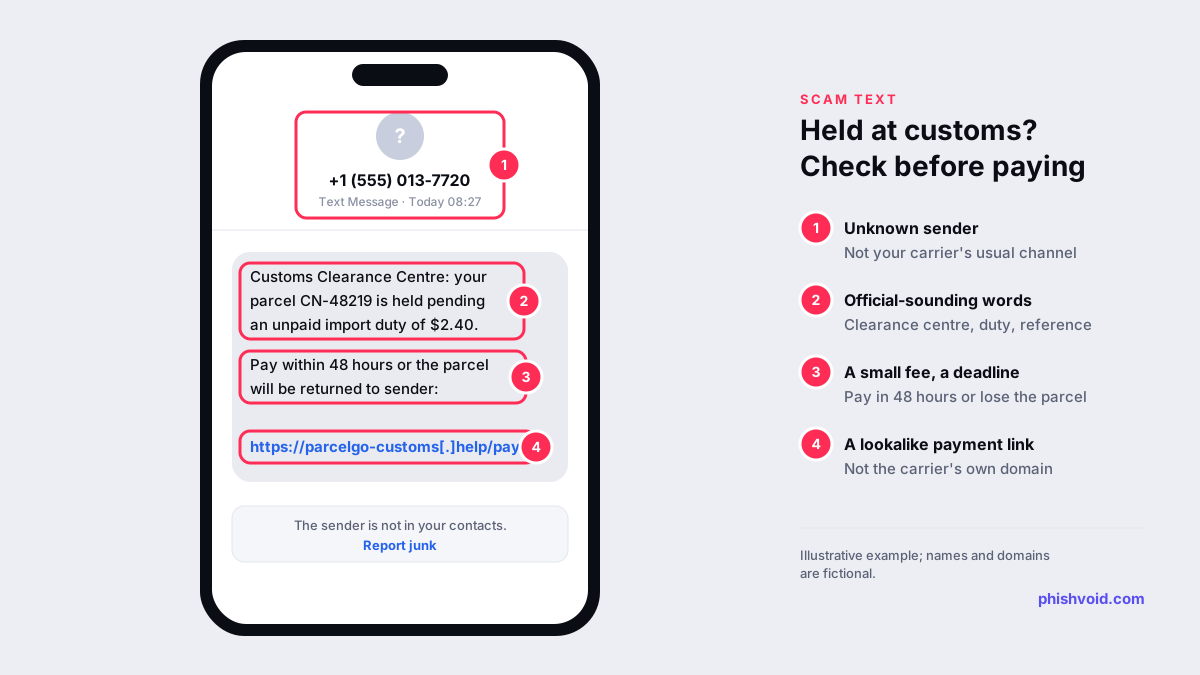
The message borrows the language of import paperwork to sound official. Typical features:
- A parcel "held at customs". It mentions customs clearance, an import duty, a tax or a "clearance centre", sometimes with a made-up reference number.
- A sender that claims authority. The text names a customs agency, a tax office or a postal or courier brand. Royal Mail's scam advice lists messages that pretend to be HMRC or customs among the common signs of a scam.
- A small amount and a deadline. Pay a few dollars or pounds within 24 or 48 hours, or the parcel will be returned, destroyed or charged storage.
- A link to a payment page. The page copies a carrier's or government's look and asks for your card details. Some also ask for a passport number, date of birth or other ID.
The small amount is the point. In its review of the top text scams of 2024, the FTC said many people who paid a small delivery fee found it was a trick to get their credit card number or even their Social Security number. The fee is bait; the card details are the prize.
How real customs charges are billed
The safest rule is simple: a genuine charge can always be found on the delivering carrier's own website or app, using a tracking number you got from the seller. How the bill reaches you depends on the country.
United States
For postal shipments, the July 2025 executive order suspending de minimis treatment requires the carrier delivering the shipment, or another qualified party, to collect duties and remit them to CBP. In practice you pay the carrier or the seller, not a customs officer. A text that claims to come from "U.S. Customs" and asks you to pay through a link doesn't match how duties are collected, so check your tracking on the carrier's site instead.
United Kingdom
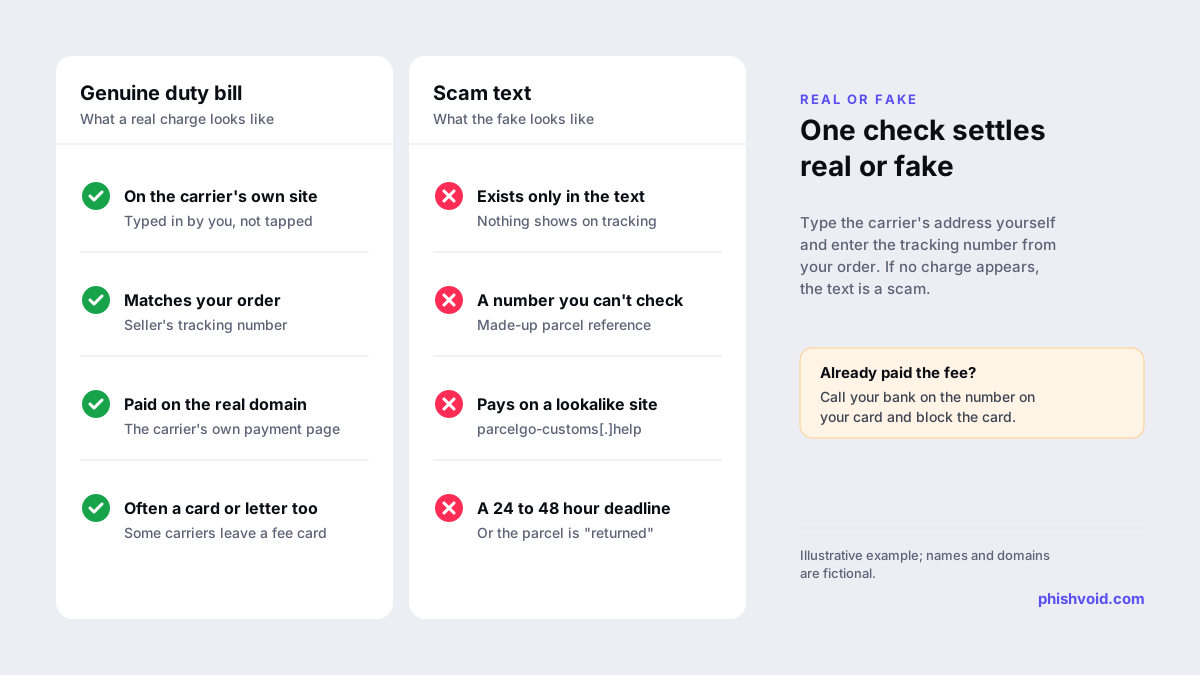
Royal Mail's scam advice is one of the clearer official descriptions of a genuine notice. Royal Mail says it may send an SMS or email about a customs fee where the sender has provided your contact details, and that it also leaves a grey "Fee to Pay" card. It also says it will not ask you to enter information on a website that is not part of Royal Mail. So a real notice comes with a card and a payment page on the carrier's own domain; a text that sends you anywhere else is not genuine.
Canada
The CBSA says it never asks for payment or personal information by text, and that a message claiming you must pay duties on a package the CBSA is holding is a scam. It advises ignoring the message and reporting it to the Canadian Anti-Fraud Centre.
How to check a customs fee text in five minutes
- Ask whether you're expecting an international parcel. If you haven't ordered anything from abroad, the text is a scam.
- Find the carrier and tracking number in your order confirmation, not in the text.
- Type the carrier's website address yourself or open its official app, and enter that tracking number. If a duty is due, the carrier's own tracking page or account will show it.
- Check whether duties were already paid. Some sellers include import charges at checkout, so your order confirmation may already show them.
- Read the domain in the text from right to left. A payment page that isn't on the carrier's or government's real domain is fake, whatever the logo says. Our guide to typosquatting and lookalike domains shows the usual tricks.
If the carrier's site shows no charge, or the tracking number from the text doesn't exist, you can safely ignore the message and report it.
Where to report a customs fee scam text
In the United States
- Forward the text to 7726 (SPAM) or use your phone's report junk option, then delete it.
- Report it to the FTC at ReportFraud.ftc.gov, and to the FBI's IC3 if you lost money.
- If the text used the Postal Service's name, the U.S. Postal Inspection Service asks you to email the message text and a screenshot to
spam@uspis.gov, as described on its smishing page.
In the United Kingdom
- Forward the text to 7726. It's free and reports the message to your mobile provider, as GOV.UK explains in its guide to reporting suspicious messages.
- If it used Royal Mail's name, Royal Mail asks you to send a screenshot to
reportascam@royalmail.com. - Report the payment site through the NCSC's scam website reporting service.
- If you lost money, report it to Report Fraud. In Scotland, contact Police Scotland on 101.
In Canada
- Report it to the Canadian Anti-Fraud Centre through its online reporting system, as the CBSA recommends.
For other countries, see our guide on how to report a scam.
If you already paid the fee
- Call your bank or card issuer now, on the number printed on your card. Ask them to block the card and dispute the payment, even if the amount was tiny. The card details matter more than the fee.
- Watch your statements for small test charges and larger ones that follow.
- If you entered a passport number, Social Security number or other ID, US residents can get a recovery plan at IdentityTheft.gov. Elsewhere, tell the police when you report the fraud.
- Be suspicious of a "refund" call. Scammers who have your number may call next, pretending to be your bank or the carrier. Hang up and call the official number yourself.
Our I got phished page walks through the next steps in more detail.
For carriers and online sellers
Customs scams work because they copy a real step in cross-border shopping. Carriers and sellers can make the real step easy to recognise: publish the exact domain where duties are paid, show the charge on the tracking page, and say in shipping emails whether duties were already collected at checkout. The fake payment pages are the part that can be removed. Phishvoid finds and takes down lookalike carrier and payment sites for brands, verifying each one before reporting it to hosts, registrars and browser blocklists.
FAQ
Does customs text you about fees?
Customs agencies generally don't text consumers asking for payment. If a duty is due, the postal service or courier delivering your parcel bills you, and the charge appears on its own tracking page.
Can a genuine customs fee notice arrive by text?
Yes, from some carriers. Royal Mail, for example, says it may text or email about a customs fee and also leaves a grey Fee to Pay card. Check the charge by typing the carrier's address yourself rather than tapping the link.
Why is the customs fee in the text so small?
A small amount gets paid without much thought. The real goal is your card number and personal details, which can be used for much larger fraud.
I paid a small customs fee through a text link. What now?
Call your bank on the number on your card, block the card and dispute the charge. Then report the text and watch for follow-up calls.
Is someone impersonating your brand?
We find lookalike domains and cloned pages and take them down. Start with a free exposure scan.