Found a fake online store using your brand? Learn how to confirm it, collect evidence, report it to platforms, registrars and Google, and protect customers.
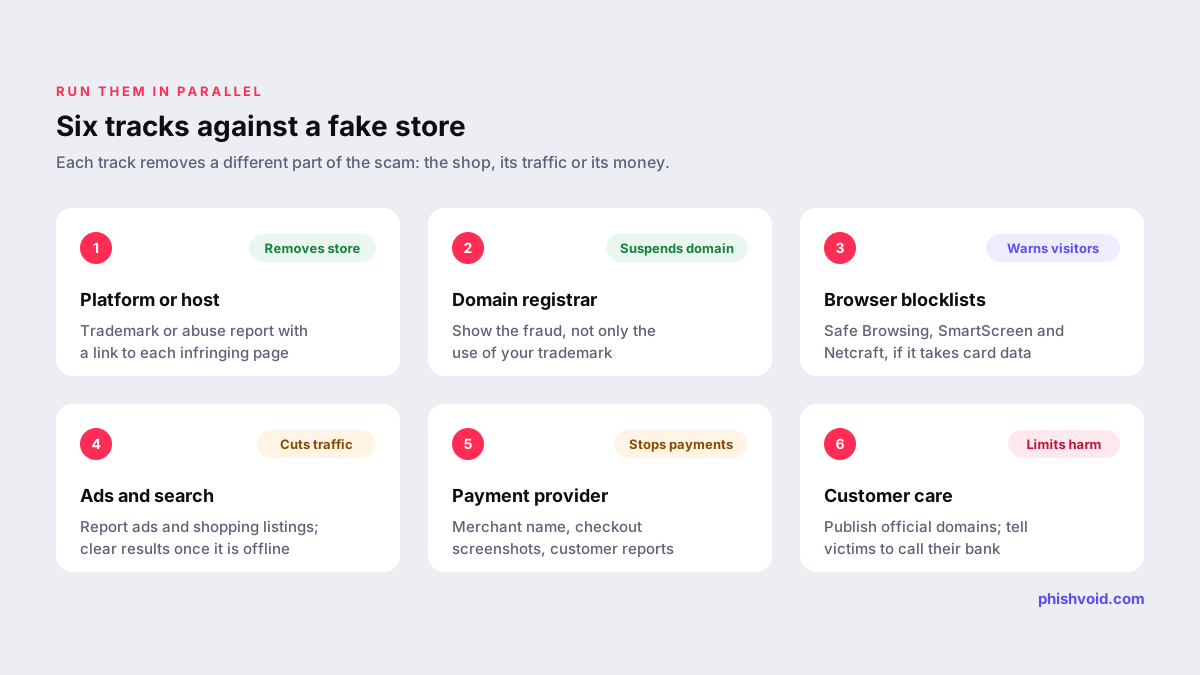
Quick answer: If a fake online store is using your brand, first confirm what kind of store it is and capture evidence of every product and checkout page. Then report it on several tracks at once: the hosting or e-commerce platform, the domain registrar, browser blocklists if it collects card data, the ads and search results that send it traffic, and the payment provider shown at checkout. While those reports run, warn customers through your own channels and tell your support team how to help people who already paid.
This guide is written for brand owners and the people who protect them. It focuses on what is different about fake shops compared with fake login pages: product pages, payments, ads and angry customers.
First, work out what kind of fake store it is
"Fake store" covers several different problems, and each one points to a different set of routes:
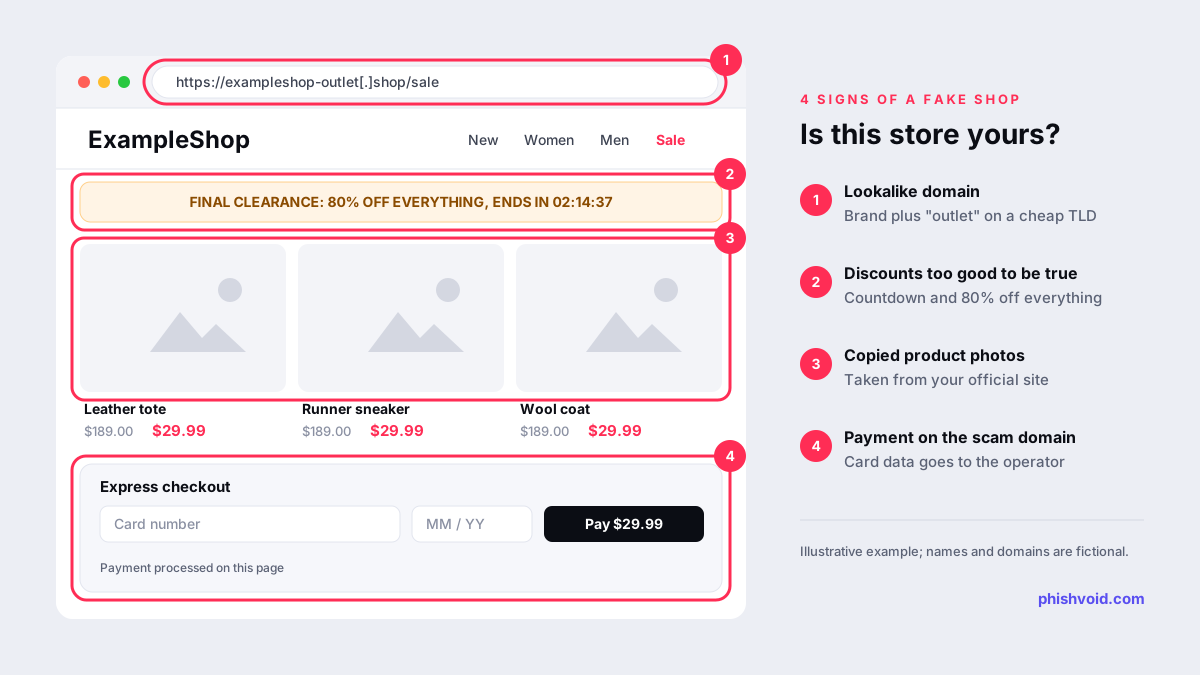
- Non-delivery scam. The store takes payment and ships nothing. Prices are often far below normal, with a "closing down" or "final clearance" story.
- Counterfeit shop. The store ships goods, but they are fakes carrying your trademark.
- Phishing checkout. The shop exists mainly to capture card numbers, one-time codes or account logins on a payment page it controls.
- Unauthorized reseller. Someone sells genuine products without your approval. That can be a contract or trademark issue, but it is not necessarily fraud, and reporting it as a scam can backfire.
Many fake shops mix the first three. Note which elements you see, because hosts and platforms ask what harm the site causes, not only that it uses your name.
Collect evidence that platforms accept
Commerce platforms and hosts are stricter than blocklists about evidence. Gather it once, in a shared folder, and reuse it for every report:
- Individual URLs for product, cart and checkout pages, not just the home page. Some platforms reject a general shop link.
- Dated screenshots of each page with the address bar visible, on mobile and desktop.
- Your rights: trademark registration numbers, the countries where each mark is registered and the classes of goods it covers, plus links to the original images or text that were copied.
- Payment details shown at checkout, such as the merchant name, payment processor or bank account. Do not enter real card data to see the next step.
- Traffic sources: the ads, social posts, emails or search results that point to the store.
- Customer reports with order numbers and dates, shared with permission.
If you need a structured order of operations for the first day, our first 24 hours playbook covers evidence, blocklisting and takedown in sequence.
Where to report a fake store using your brand
The hosting provider or e-commerce platform
Many fake shops run on hosted store builders. Most of them have an intellectual property or abuse process. Shopify, for example, takes trademark notices through an online form and asks for your contact details, links to each infringing page, the registration number and countries for each mark, an explanation of the infringement and a statement made under penalty of perjury. Other platforms ask for similar details. If the store is self-hosted, find the host from the IP address and write to its abuse contact. Our abuse report generator drafts a clear report from your evidence.
The domain registrar
Look up the domain with ICANN Lookup to find the registrar and its abuse address. A domain set up purely to defraud customers is a strong case for suspension, which takes every page offline at once. Explain the fraud as well as the trademark use, since registrars act more readily on clear abuse than on brand disputes.
Browser blocklists
If the store collects card details or logins, report it as phishing to Google Safe Browsing, Microsoft's Report unsafe site form and Netcraft. Warnings can appear in browsers before the host or registrar acts.
Ads and search results
Fake shops live on paid traffic. Google's Report an ad or shopping listing form covers both scams and trademark or counterfeit complaints. Report social media ads through each platform's own ad and intellectual property reporting tools. For organic results that rank for your brand, see how to remove a scam site from Google Search.
The payment provider
A shop that cannot take payments cannot make money. If the checkout names a payment processor or shows a bank account, report the merchant to that provider through its official fraud or abuse contact, found on its own website. Include the store URL, screenshots of the checkout and any customer complaints.
When the domain itself contains your trademark
If the store's domain name copies your trademark, for example exampleshop-outlet[.]shop, you have an extra option: the UDRP, a dispute process for generic top-level domains that can transfer or cancel a domain registered and used in bad faith. It is a legal process with fees; WIPO lists USD 1,500 for one to five domain names decided by a single panelist. It is slower than an abuse report, so use it alongside suspension requests, mainly when you want control of a domain that keeps being reused. Talk to your trademark counsel before filing.
Protect customers while the store is live
- Publish your official domains. A short notice on your website listing your real shop addresses helps customers check before they buy. Don't post the fake store as a clickable link.
- Brief customer support. Give agents a script: confirm the store is not yours, collect order details for your evidence folder and point the customer to their bank or card issuer about disputing the payment.
- Watch for complaints aimed at you. Victims often blame the real brand in reviews and on social media. A calm, consistent reply limits the damage.
- Involve legal and privacy colleagues if customers' data may have been collected, since notification duties may apply.
Stop the next fake store
Fake shops come in waves, often from the same operators reusing one template on new domains. A few habits shorten each wave:
- Monitor new domain registrations that combine your brand with words like "outlet", "sale" or "store". Our lookalike domain finder shows common variations.
- Check paid search and social ads for your brand name regularly, especially before seasonal sales.
- Keep a ready evidence template, trademark details and a letter of authorization for any agency that reports for you.
- Track the template's fingerprints, such as page titles, image file names and the payment processor, to link new stores to old ones.
Phishvoid monitors for lookalike domains and cloned stores, verifies each one with a human analyst and reports it to blocklists, hosts, registrars, CDNs, search engines and social platforms, under one subscription with unlimited takedowns. Timing varies by provider; our article on how long it takes to take down a phishing site explains what drives it.
FAQ
Can I sue the people behind a fake online store?
Possibly, but operators usually hide behind privacy services and offshore hosting, which makes court action slow and costly. Most brands start with abuse reports, platform complaints and, for infringing domains, the UDRP. Ask your counsel which legal options fit your jurisdiction.
Should I place an order to prove the store is fake?
Don't use a real card or personal account. Screenshots of the checkout, payment details and customer reports are usually enough. If you need to see the payment step, stop before entering any card data.
Is an unauthorized reseller a fake store?
Not necessarily. Selling genuine goods without your approval is a commercial or trademark matter, not fraud. Report it as a scam only if it takes payment without delivering, sells counterfeits or steals data.
What should I tell customers who already paid?
Confirm that the store is not yours, ask them to contact their bank or card issuer about the payment, and collect their order details for your reports. Victims can also report the store to the consumer protection or fraud reporting agency in their country.
Is someone impersonating your brand?
We find lookalike domains and cloned pages and take them down. Start with a free exposure scan.