A pig butchering scam mixes online romance or friendship with fake crypto trading. Learn the warning signs, how to check a platform and where to report.
Quick answer: A pig butchering scam is a long-running investment fraud in which a stranger builds a friendship or romance with you online, then persuades you to invest, usually in cryptocurrency, through a fake trading platform. The platform shows growing profits, but when you try to withdraw you are told to pay "taxes" or "fees", and the money is gone. If someone you have never met in person is coaching you to invest, stop sending money, keep every message and transaction record, and report it, in the US to the FBI at ic3.gov.
The name comes from the scammers themselves. The US Treasury's Financial Crimes Enforcement Network (FinCEN) explained in a September 2023 alert that the scam resembles fattening a hog before slaughter: victims are "fattened up" with trust before their money is taken. Authorities also call it a relationship investment scam or cryptocurrency investment fraud. This guide covers how it unfolds, the warning signs, how to check a trading platform and what to do if you or someone close to you is caught in one.
How big the problem is
The FBI's 2025 Internet Crime Report says cryptocurrency investment fraud was the highest source of financial losses to Americans in 2025, with $7.2 billion reported lost across 61,559 complaints. That was a 48% rise in complaints and a 25% rise in losses from 2024. People aged 60 and over reported the largest share, about $2.76 billion.
The same report says these scams are largely run by organised criminal groups based in Southeast Asia that use victims of human trafficking as forced labour. FinCEN's alert describes the same pattern. That is why the messages read like a script: the person writing to you is often working from one.
How a pig butchering scam unfolds
The FBI describes the scams as sophisticated long-term schemes that use psychological manipulation and the appearance of legitimacy. Most follow five stages:
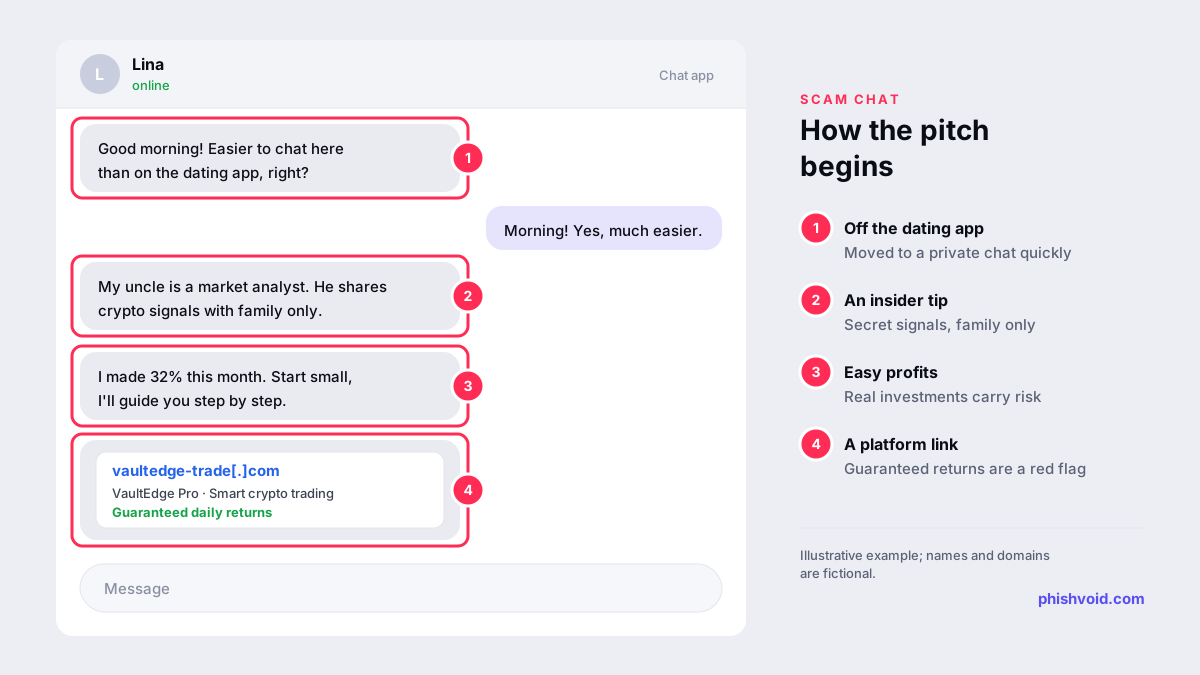
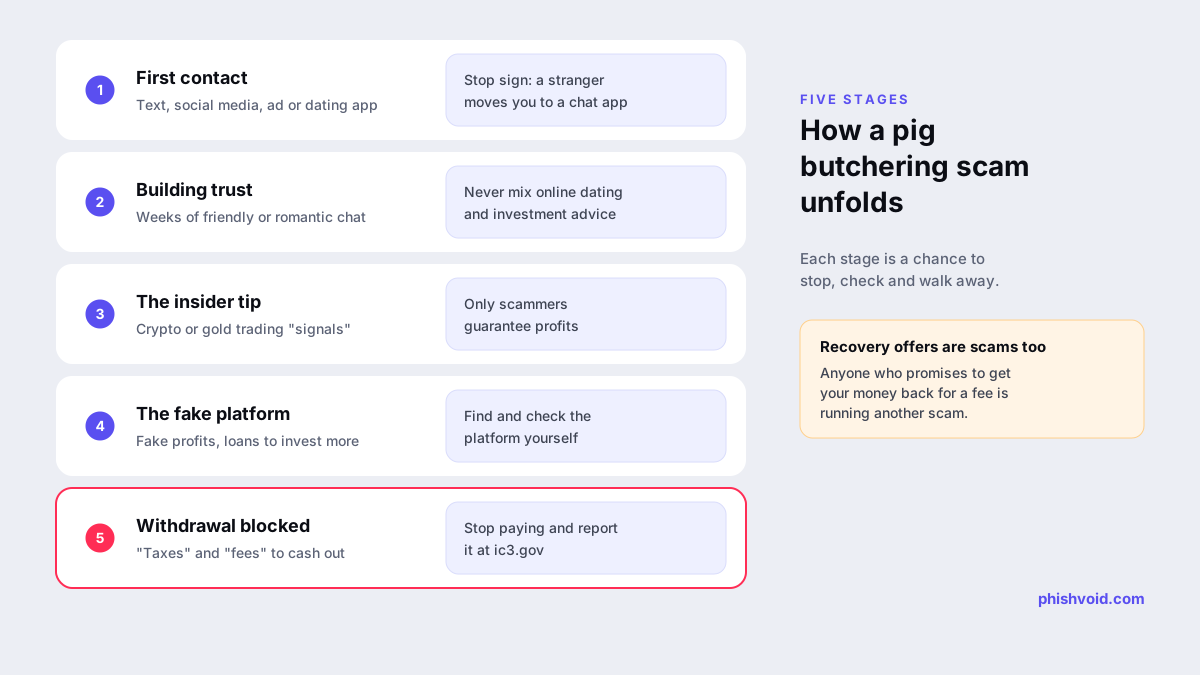
- First contact. A text, a social media message, an advert or a dating app match. The FBI says scammers typically start there and then quickly move the conversation to a messaging app.
- Building trust. Days or weeks of friendly, often romantic chat. Money isn't mentioned at first. The person shares photos, routines and life stories.
- The opportunity. They mention their own trading success, or introduce you to an investment group of "industry insiders" offering guidance on crypto or gold.
- The fake platform. You are guided to a trading website or app. The FBI says victims are shown fake profits and offered loans to encourage larger investments.
- The slaughter. When you try to withdraw, you are charged "taxes" and "fees" as a last attempt to extract money before the scammers disappear with everything.
Warning signs to look for
The Federal Trade Commission's guide to cryptocurrency and scams gives three short rules that cover most cases: only scammers guarantee profits or big returns, only scammers demand payment in cryptocurrency, and you should never mix online dating and investment advice. In practice, watch for:
- Someone you haven't met in person who talks about investing. Especially a new friend or partner who keeps finding reasons not to video call or meet.
- Guaranteed or steady returns. Real investments go up and down. A platform that only shows gains is showing you numbers it made up.
- A platform you can only reach through their link. Or one you can't find in your phone's official app store, or that you are told to install from a file or a link.
- Pressure to invest more. Time-limited opportunities, VIP levels, offered loans or encouragement to borrow against your home or retirement savings.
- Fees to withdraw. Being told to pay tax, a deposit or an "unlocking" fee before you can take out your own money.
- Requests for secrecy. Being asked not to tell your bank or family, or to give a false reason for a large transfer.
Fake investment adverts and deepfake celebrity endorsements are often the first touch point. Our guide to fake ads and deepfake investment scams covers that side.
How to check a trading platform before you invest
- Find it yourself. Search for the company independently, not through the link you were sent. Scam platforms often use new domains made to look like known brands.
- Check registration. In the US, the SEC and CFTC run public lookup tools, and most countries have a financial regulator with a register of authorised firms. A platform that isn't registered anywhere is a red flag.
- Don't treat a small withdrawal as proof. Being allowed to take out a little can be part of the act. Being asked for a fee, tax or deposit before you can withdraw is the real test: stop sending money.
- Run our checklist. The eight checks in how to tell if a crypto exchange is legit apply to trading apps too.
If the platform turns out to be a clone of a real exchange or broker, you can report it to the real company and to browser blocklists. Anyone can also send us a scam site to check.
Scammed? What to do now
- Stop paying. Don't send more money, even for a "tax", "fee" or "verification" step to release your balance. No payment will release it.
- Keep everything. Save chat histories, usernames, phone numbers, the platform's web address, wallet addresses and transaction hashes, bank transfer receipts and dates.
- Tell your bank or exchange. If you sent money from a bank account or bought crypto on an exchange, contact them straight away. Fast reports give the best chance of stopping a transfer that hasn't settled.
- Report it. In the US, file a complaint at ic3.gov and at ReportFraud.ftc.gov. The FTC also lists the CFTC, the SEC and the exchange you used as places to report. In other countries, see how to report a scam.
- Watch for recovery scams. Victims are often targeted again by people who promise to recover the money for a fee, including fake law firms and people posing as government officials. The FBI's 2025 report counted 10,516 recovery scam complaints with $1.4 billion in reported losses.
- Get support. These scams cause real emotional harm as well as financial loss. Talk to someone you trust; you are not the first person this has happened to.
Our I got phished page has more on securing accounts and documents after a scam.
If the FBI calls you: Operation Level Up
Sometimes the warning comes from the authorities first. Under Operation Level Up, launched in January 2024, the FBI identifies people who are being defrauded and contacts them directly. The FBI's 2025 report says the operation has notified more than 8,000 victims and saved them over $500 million, and that 78% of the 3,780 people notified in 2025 didn't know they were being scammed. The FBI says it will never ask you for money or to move your assets. A caller claiming to be the FBI who asks for either is another scammer, so verify through a number you look up yourself.
FAQ
What does pig butchering mean?
It is the scammers' own term. Victims are "fattened" with friendship, romance and fake profits before their money is taken, the "butchering". Authorities also call it a relationship investment scam or cryptocurrency investment fraud.
How do pig butchering scammers find victims?
The FBI says they typically make contact through text messages, social media, advertisements or dating apps, then quickly move the conversation to a messaging app.
Can I get my money back from a pig butchering scam?
It is difficult, especially once crypto has moved. Report quickly to your bank or exchange and to ic3.gov, keep all records and never pay anyone who promises recovery for a fee.
Why does the platform show profits if it is a scam?
The balance is just numbers on the scammers' own website or app. Showing growing profits, and sometimes offering loans, encourages larger deposits. Withdrawals are then blocked with demands for taxes or fees.
Is someone impersonating your brand?
We find lookalike domains and cloned pages and take them down. Start with a free exposure scan.