Got a text about an unpaid toll? It is probably a scam. Learn the warning signs, how to check your real toll account and how to report it in the US and UK.
Quick answer: A text saying you owe an unpaid toll and must pay through a link to avoid a late fee is almost certainly a scam. The US Federal Trade Commission says such texts are probably a scam. Don't click or reply. Check your balance through the toll operator's official website or app, or a phone number you already trust. Then report the text by forwarding it to 7726 and delete it. In the US you can also report it at ReportFraud.ftc.gov or ic3.gov; in the UK, report it to Report Fraud if you lost money.
This guide explains what the unpaid toll text scam looks like, how to check whether you really owe anything, where to report it in the US and the UK, and what to do if you already paid. For general advice on checking any link in a text, see our guide to phishing links and texts.
What the unpaid toll text scam looks like
The FBI's Internet Crime Complaint Center (IC3) first warned about the campaign in April 2024. Its public service announcement said it had received more than 2,000 complaints since early March 2024 about texts posing as road toll collection services in at least three states, that the scam appeared to be moving from state to state, and that the sending phone numbers changed between states. The texts claim you owe an unpaid toll, usually threaten a late fee, and link to a website that imitates the state's toll service.
It has not gone away. In May 2026 the FTC reported that reports of government imposter scams were up 40%, partly because of messages about overdue tolls, and that these messages may spoof real toll programmes and threaten late fees or suspension of your vehicle registration (FTC). Close relatives of the scam include fake overdue traffic ticket texts that impersonate state motor vehicle departments.
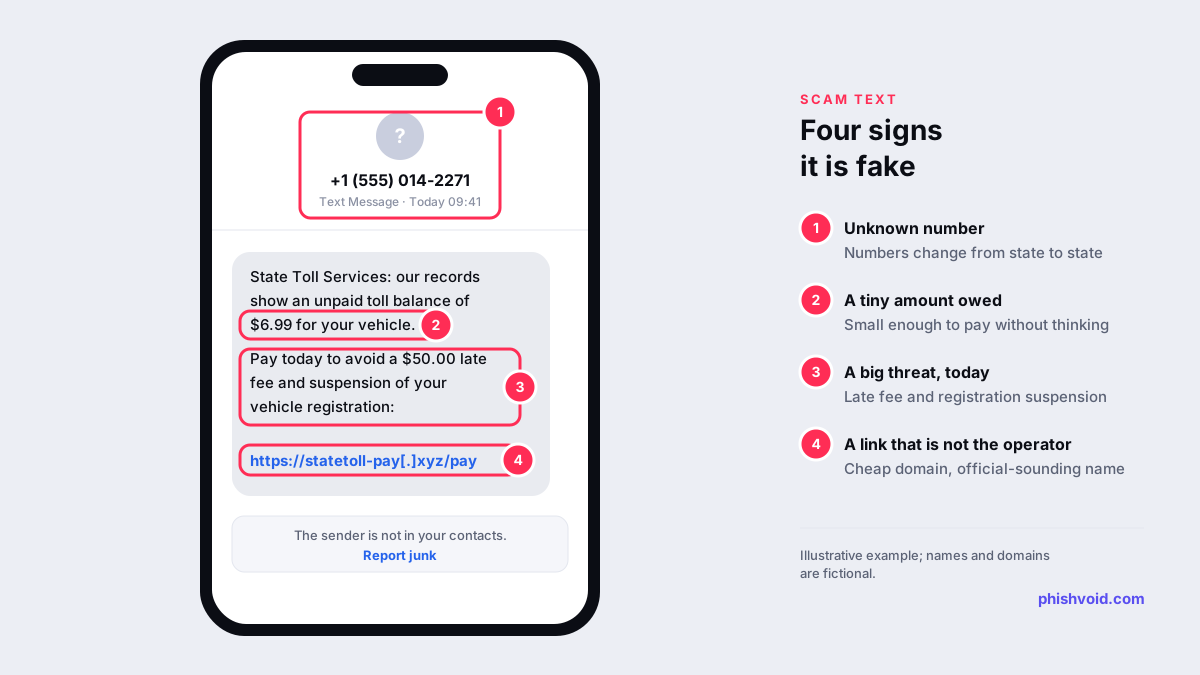
Signs the toll text is fake
- You didn't expect it. You haven't driven on a toll road recently, or not in the state the message names.
- A small amount, a big threat. A few dollars or pounds owed, with a much larger late fee, fines or suspension of your registration or licence if you don't pay today.
- A link that isn't the operator's real domain. Toll scam sites use names that sound official, often with words like toll, pay or service, on cheap domain endings. Read the domain carefully before anything else; our guide to lookalike domains shows the tricks.
- An odd sender. The text comes from an unfamiliar phone number or even an email address rather than a short code you recognise.
- Requests for more than payment. The FTC says the fake pages ask for bank or card details and can also collect personal information such as your driver's licence number.
One caution: some toll operators do send genuine text alerts about your account. That is why the safe test is not whether you received a text, but whether the balance appears when you check your account yourself.
How to check whether you really owe a toll
- Don't use anything in the message, not the link, not the phone number and not a QR code.
- Open the operator's official website or app yourself, from a bookmark or a previous statement, and sign in to your account or search by plate number.
- Or call the operator on a number from its official website or your paperwork. The IC3 advises contacting the toll service's customer service using a phone number you have verified.
- Be careful with search results. In the UK, National Highways warns that unofficial Dart Charge sites can appear in search results and charge more than the standard charge, and encourages paying through the official GOV.UK Dart Charge service (National Highways).
If your real account shows nothing outstanding, the text was a scam.
How to report an unpaid toll text scam
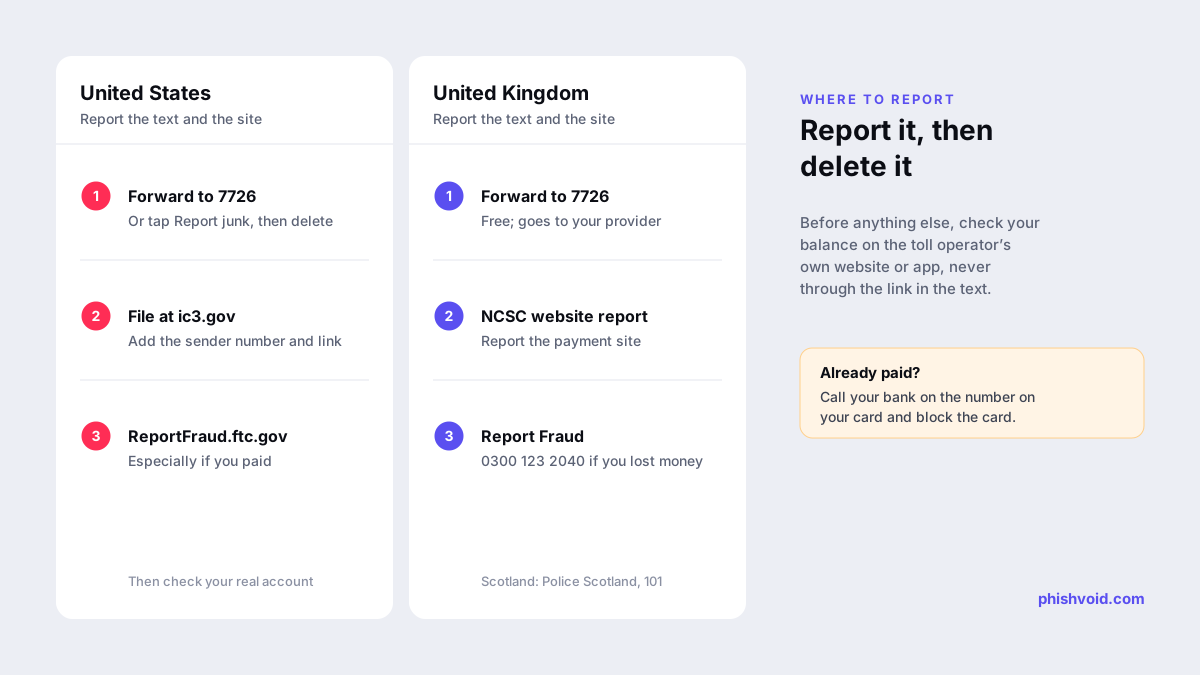
In the United States
- Forward the text to 7726 (SPAM), or use your phone's "report junk" option, then delete it. This is the FTC's advice in its unpaid toll alert.
- File a complaint with IC3 at ic3.gov. The FBI asks you to include the phone number the text came from and the website address in the message.
- Report it to the FTC at ReportFraud.ftc.gov, especially if you paid or shared details.
In the United Kingdom
- Forward the text to 7726. GOV.UK's guide to reporting suspicious messages and websites says this is free and reports the message to your mobile provider.
- Report the website through the NCSC's scam website reporting service.
- If you lost money or shared details, report it to Report Fraud online or on 0300 123 2040. It replaced Action Fraud in England, Wales and Northern Ireland in December 2025. In Scotland, call Police Scotland on 101.
For other countries and other kinds of scams, our guide on how to report a scam lists the official channels.
If you already paid or entered your details
- Call your bank or card issuer now, using the number on your card, and ask them to block the card and dispute the payment. The FTC's guide What To Do if You Were Scammed explains the options for each payment method.
- Watch your statements for charges you don't recognise. The IC3 advises securing your financial accounts and disputing unfamiliar charges.
- If you gave your driver's licence number or other ID details, US residents can get a recovery plan at IdentityTheft.gov.
- Expect follow-up contact. Scammers who have your number may call pretending to be your bank's fraud team. Hang up and call the bank yourself.
Our I got phished page has a fuller checklist.
For toll operators: the sites matter more than the numbers
Sending numbers change constantly, so blocking them one at a time has limited effect. The payment websites are the part of the scam that can be removed for good: report them to the hosting provider, the registrar and browser blocklists such as Google Safe Browsing as soon as they appear, and publish on your own site which domains and short codes you really use. Phishvoid finds and takes down these lookalike payment sites for operators and other brands, verifying each one before reporting it.
FAQ
Do toll agencies send text messages?
Some do send genuine account alerts, so a text alone proves nothing. Never pay through a link in a text; check your balance on the operator's official website or app instead.
I clicked the link but didn't enter anything. Am I safe?
The risk is much lower if you entered nothing. Close the page, don't return to it, keep your phone updated and report the text. If you entered card details, call your bank.
Should I reply STOP to a toll scam text?
No. Replying tells the sender your number is active. Forward it to 7726, report it and delete it.
Why did I get a toll text for a state I have never visited?
Scammers send these texts in bulk to large lists of numbers. They don't know where you drive, which is why a demand for a road you never used is a clear warning sign.
Is someone impersonating your brand?
We find lookalike domains and cloned pages and take them down. Start with a free exposure scan.