An AI voice cloning scam fakes the voice of a relative or boss to demand money. Learn the warning signs, how to verify a call and what to do if you paid.
Quick answer: An AI voice cloning scam is a phone call or voice message in which a criminal uses AI to imitate the voice of someone you know, usually a family member, a boss or a senior colleague, and asks for urgent help: money, a payment, a one-time code or confidential information. Because the voice can sound exactly right, don't trust it on its own. Hang up, call the person back on a number you already have, and agree on a family code word in advance.
The US Federal Trade Commission warned in March 2023 that a scammer needs only a short audio clip of a family member's voice, which can come from content posted online, to make a call sound like them (FTC). Since then the FBI has repeatedly warned that criminals use AI-generated audio to impersonate relatives, company executives and even senior government officials (FBI). Voice cloning is a form of vishing and one of the most personal kinds of AI phishing.
How an AI voice cloning scam works
- Collecting a voice sample. Videos on social media, podcasts, interviews, conference talks and even voicemail greetings can provide the audio.
- Cloning the voice. Widely available tools turn the sample into a synthetic voice that can say whatever the scammer types.
- Making contact. The scammer calls, leaves a voicemail or sends voice notes on a messaging app. The number shown may be faked: the FCC explains that callers can deliberately falsify the information that appears on caller ID (FCC).
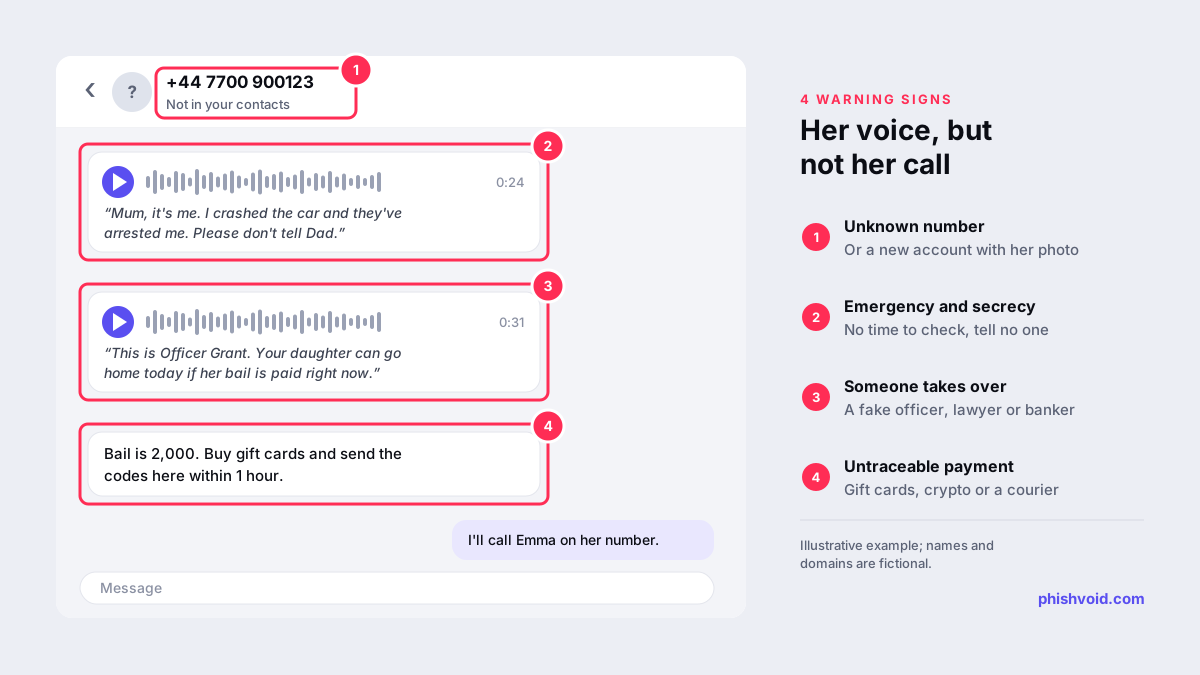
- The emergency. An accident, an arrest, a lost phone, a deal that must close today. The story is designed to make you act before you think, and it often comes with a reason to keep it secret.
- The hand-off and the payment. The "relative" may pass the phone to a supposed lawyer, police officer or bank employee. Payment is requested by wire transfer, cryptocurrency, gift cards or cash collected by a courier. The FTC lists wire transfers, cryptocurrency and gift cards as payment requests to be suspicious of.
Two common versions: family and business
The family emergency call
The classic "grandparent scam" now often uses a cloned voice. The FBI's 2025 Internet Crime Report says victims reported losses of over $5 million in 2025 to "distress" scams in which voice cloning mimics a loved one, and that these scams are evolving to imitate other family members and close friends (FBI IC3). That figure covers only complaints made to the FBI, so actual losses are higher.
The boss or executive call
At work, the cloned voice belongs to a manager or senior leader, and the request is a payment, a password reset or sensitive files. In April 2024 the password manager company LastPass disclosed that an employee had received WhatsApp calls, texts and a voicemail with deepfake audio impersonating its CEO. The employee ignored the messages because they came through a channel outside normal business communication, reported them, and the company said there was no impact (LastPass). In May 2025 the FBI warned of a campaign that used AI-generated voice messages impersonating senior US officials to gain access to targets' accounts (FBI IC3).
Cases that combine voice and video to steal company funds are covered in our guide to the deepfake CEO scam. Cloned voices of celebrities and executives also appear in fake investment ads, which we cover in fake ads and deepfake investment scams.
Warning signs: don't rely on the voice
A good clone can sound exactly right, so look at the situation instead:
- The call comes from an unknown number or a new messaging account, or a familiar number asks for something unusual.
- There is an emergency, and you are told there is no time to check.
- You are asked to keep it secret from family or colleagues.
- Payment must be made by wire, cryptocurrency, gift cards or a courier collecting cash.
- The caller avoids questions, the line "breaks up" when you ask something personal, or another person takes over the call.
- The tone or choice of words feels slightly off. The FBI advises listening for this, but it is not reliable on its own.
Our two-minute is this a scam? checklist applies to calls as well as messages.
How to protect yourself and your family
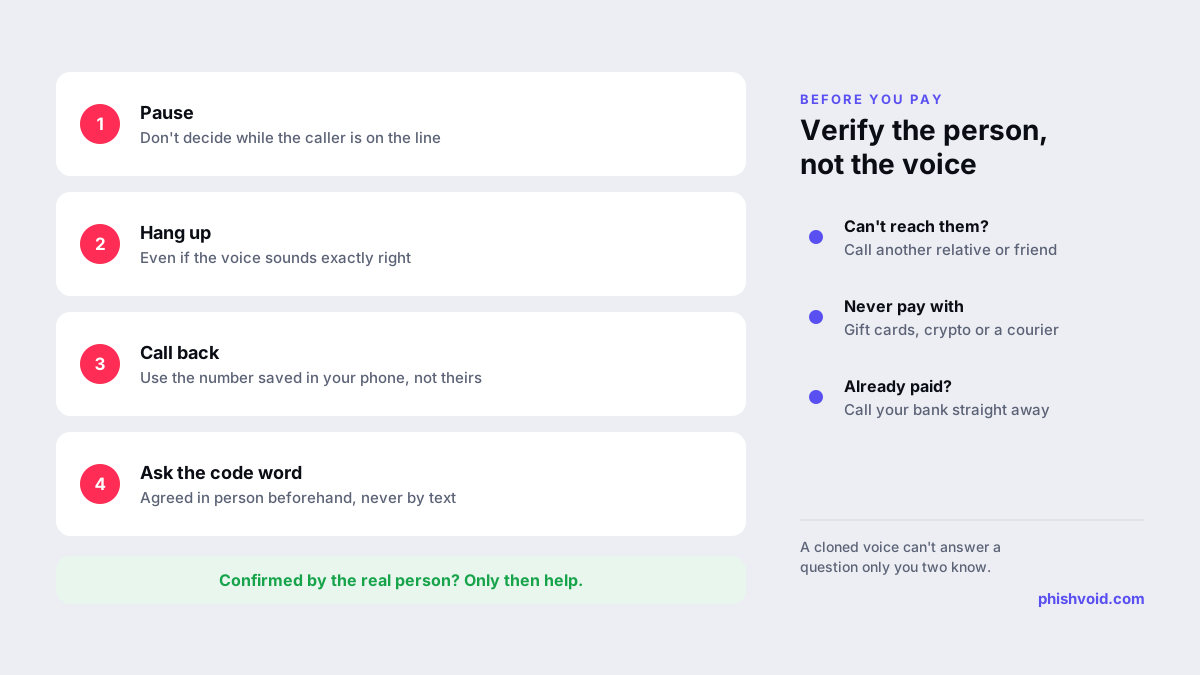
- Hang up and call back. Use a number you already have for the person, not one the caller gives you. If you can't reach them, contact another family member or a friend who can. This is the FTC's core advice.
- Agree on a code word. The FBI recommends creating a secret word or phrase with family members to verify identity (FBI). Choose something that can't be found online, and agree on it in person rather than by text.
- Ask a question only the real person could answer. Something recent and private works better than a birthday or a pet's name, which may be visible online.
- Limit public audio and video where you can. The FBI suggests limiting online content of your image or voice and keeping social media accounts private. A generic voicemail greeting gives scammers less to work with.
- Slow every payment down. No genuine emergency is solved with gift cards or by handing cash to a courier at your door.
- At work, use verification rules. Requests for payments, password resets or data that arrive by voice should be confirmed through a known channel, and staff should know they will never be blamed for checking.
What to do if you paid or shared information
- Contact your bank or payment provider immediately and ask them to stop or recall the payment. For gift cards, contact the card issuer; for cryptocurrency, the exchange you used.
- Secure your accounts. If you shared a password or a one-time code, change the password through the official app or website and check your sign-in settings.
- Report it. In the US, report to the FTC at ReportFraud.ftc.gov and to the FBI at ic3.gov. In England, Wales and Northern Ireland, report to Report Fraud. Our guide on how to report a scam covers other countries.
- Warn the person who was impersonated. Their voice may be used again on other relatives or colleagues.
- Keep the evidence: the number, call times, voicemails, messages and payment receipts.
Are AI-voiced calls legal?
In the US, the Federal Communications Commission ruled in February 2024 that AI-generated voices count as "artificial" voices under the Telephone Consumer Protection Act (FCC). Robocalls that use them fall under the same consent rules as other prerecorded calls, and the ruling gives the FCC and state attorneys general another enforcement tool. Fraud is illegal whatever technology is used, but a ruling will not stop a criminal calling from abroad, so personal verification habits remain the main defense.
FAQ
How much audio does a scammer need to clone a voice?
Not much. The FTC says a short audio clip of a person's voice can be enough, and such clips are often available from social media videos, interviews or voicemail greetings.
Can scammers make the call look like it comes from a family member's number?
Yes. Caller ID can be spoofed, so a familiar name or number on the screen does not prove who is calling. Hang up and call the person back on the number saved in your phone.
What is the best protection against voice cloning scams?
A habit, not a tool: never act on an urgent request for money or codes until you have called the person back on a known number or heard the code word you agreed in advance.
Is it illegal to use an AI voice in robocalls?
In the US, the FCC treats AI-generated voices as artificial voices under the Telephone Consumer Protection Act, so the same consent rules apply as for other prerecorded calls. Using any voice to defraud people is illegal.
Should I delete videos of myself or my family from social media?
You don't have to delete everything, but the FBI suggests limiting public content of your voice and image and keeping accounts private. A family code word protects you even if your voice is already online.
Is someone impersonating your brand?
We find lookalike domains and cloned pages and take them down. Start with a free exposure scan.