AI phishing uses generative AI to write flawless lures, clone voices and fake sites. Learn what AI changes, which checks still work and how to defend.
Quick answer: AI phishing is phishing in which criminals use generative AI to write, translate and personalize their lures, keep up convincing conversations, clone voices and faces, or build fake websites faster. It removes old warning signs such as broken grammar, but it does not change what the attacker needs from you: a click, a login, a code or a payment. Checks that verify the sender, the link and the request still work.
Security agencies have been warning about this shift for some time. In January 2024 the UK National Cyber Security Centre assessed that AI gives attackers a capability uplift in reconnaissance and social engineering, making phishing more effective and harder to detect (NCSC). In May 2024 the FBI's San Francisco field office warned that criminals were using AI tools for sophisticated phishing and for voice and video cloning (FBI). This guide explains what AI changes, what it does not, and how people and organizations can respond.
What is AI phishing?
Phishing is any attempt to trick someone into handing over credentials, money or data by pretending to be a trusted party. AI phishing is the same attack with generative AI doing part of the work. In practice, the term covers two things:
- AI-generated content: emails, text messages, social media profiles, fake documents, cloned voices and deepfake video that were created or polished with AI.
- AI-automated campaigns: tools that gather public information about each target, write a tailored message for every person and answer replies with little or no human effort.
Neither is a new kind of attack. AI makes existing attacks cheaper, faster and more convincing, especially spear phishing, which used to require hours of manual research for each target.
How attackers use AI in phishing
- Clean, natural writing in any language. AI tools produce fluent text without the spelling and grammar mistakes that once gave phishing away, and they translate lures into the target's language. The NCSC specifically notes that this makes lures harder to spot.
- Personalization at scale. A model can read a target's public profile, employer website and recent posts, then write a message that mentions a real project or colleague. In a 2024 study by researchers including Fred Heiding and Bruce Schneier, fully AI-automated spear phishing emails reached a 54% click-through rate, the same as emails written by human experts, compared with 12% for generic phishing emails in the control group (Heiding et al.). The study had 101 participants, so treat it as an indication of what is possible, not a universal rate.
- Convincing conversations. When a target replies with a question, AI helps the scammer answer quickly and consistently, keeping the story alive across email, chat and messaging apps.
- Synthetic voices and video. Cloned voices in calls and voicemails, and deepfake faces in video meetings, take phishing beyond the inbox. See our guides to the AI voice cloning scam and the deepfake CEO scam.
- Fake profiles and websites. The FBI notes that AI makes it possible to create convincing synthetic content, such as social media profiles and personalized conversations, in mass quantities (FBI IC3). The same tools help write the copy for cloned login pages and fake shops.
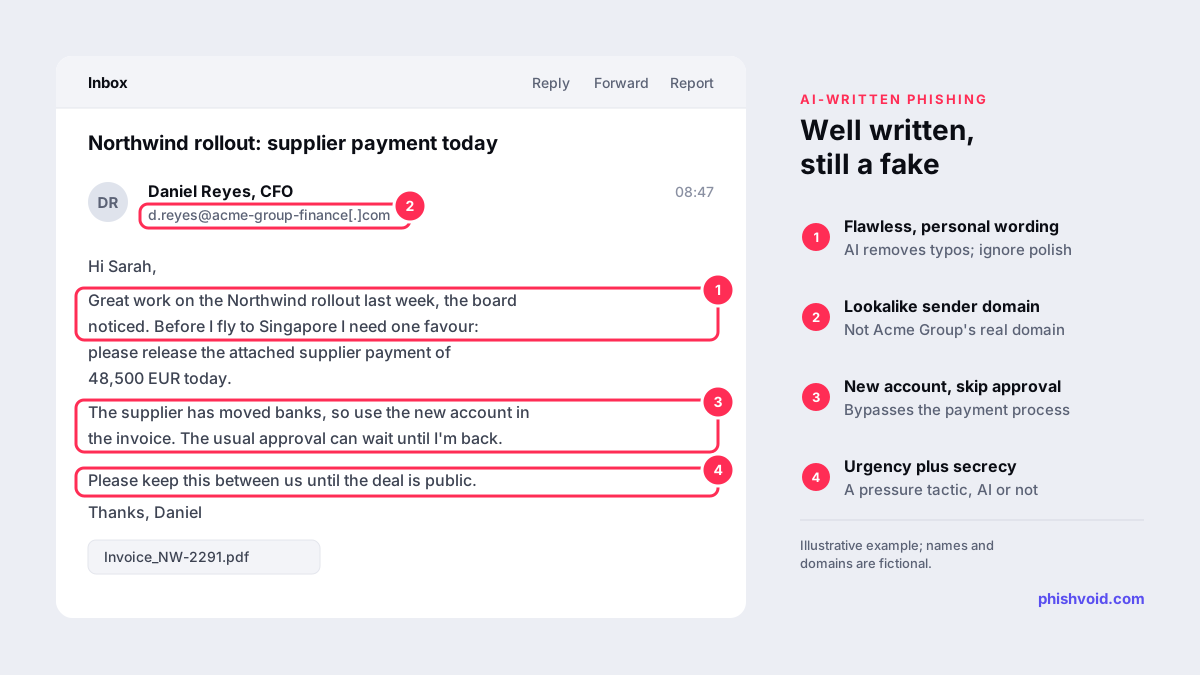
What AI changes, and what it does not
The old advice to look for typos and awkward phrasing is no longer reliable. An AI-written message can be polite, well formatted and specific to you. Volume changes too: one criminal can send thousands of individually written messages instead of a single template.
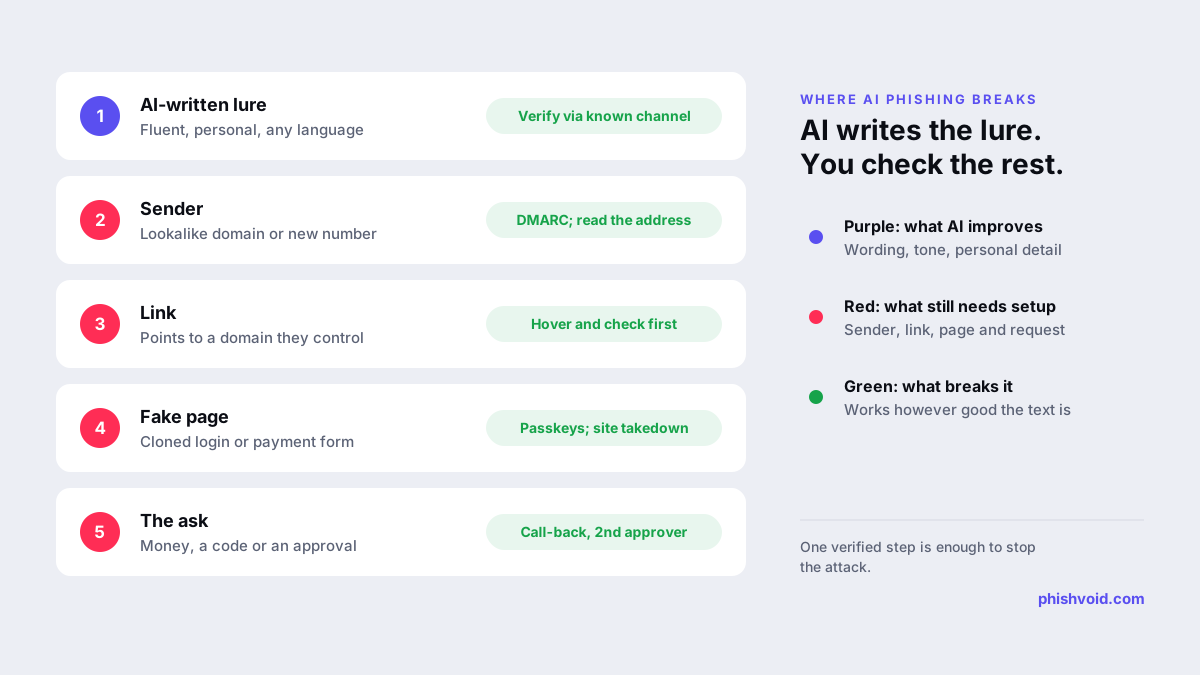
What AI does not change is the mechanics of the attack. To profit, the attacker still has to:
- send the message from somewhere, usually a lookalike domain, a free webmail account, a new phone number or a compromised account;
- send you somewhere, usually a link to a page they control;
- ask you to do something: sign in, approve a login, read out a code, open a file, pay an invoice or change bank details;
- stop you from checking, usually with urgency, secrecy or a reason to avoid normal channels.
Each of these steps can be checked, and none of them depends on how well the message is written.
Official data shows the problem is real. The FBI's Internet Crime Complaint Center received more than 22,000 complaints in 2025 that referred to AI, with adjusted losses above $893 million, and businesses reported losses of over $30 million to business email compromise scams involving AI (FBI IC3 2025 Internet Crime Report). These figures count only complaints in which AI was mentioned. The same report points out that many victims do not realize how far AI was involved, so the real share is likely higher.
How to spot an AI phishing message
Judge the message by what you can verify, not by how it reads:
- Check the sender's real address. Look past the display name to the domain after the @. A lookalike domain, or a personal webmail account for a message that should come from a company, is a red flag.
- Check where the link goes. Hover or long-press to see the real destination, or paste it into our link checker. A brand name buried inside an unrelated domain is a classic trick.
- Weigh the request, not the wording. Requests to sign in, share a one-time code, approve an MFA prompt, pay, buy gift cards or change bank details deserve verification, whoever seems to be asking.
- Notice channel switches. Being moved from email to WhatsApp, from a company meeting tool to a private call, or to a new phone number is a common step in AI-assisted scams.
- Treat urgency and secrecy as signals. "Confidential, do it today, don't tell anyone" is the same pressure tactic whether a person or a model wrote it.
- Verify through a channel you choose. Call a number you already have, open the app yourself or type the website address. This one step defeats most AI phishing, however good the message is.
For a fuller checklist with examples, see how to spot a phishing email.
How organizations defend against AI phishing
Some well-crafted messages will get through, so defenses need to hold even when someone believes the lure:
- Phishing-resistant MFA. Passkeys and FIDO2 security keys are bound to the real website, so a password typed into a fake page is not enough to get in. CISA recommends phishing-resistant MFA, starting with high-value accounts (CISA).
- Payment and data verification rules. Require a call-back to a number on file and a second approver for new payees, changed bank details and urgent transfers. Make it clear that requests from executives are not exempt.
- Email authentication. Enforced SPF, DKIM and DMARC stop criminals from sending mail from your exact domain, which pushes them toward lookalike domains that are easier to detect.
- Lookalike domain monitoring and takedowns. AI lowers the cost of writing lures, not the need for infrastructure. Finding the domains and cloned pages that imitate your brand, and getting them blocked or suspended, cuts campaigns off. Phishvoid does this as a managed service: its team verifies each site and reports it to hosts, registrars, browsers and blocklists.
- Realistic training and an easy report button. Use well-written, personalized examples in training so staff stop relying on typos, and make reporting a suspicious message a one-click action.
- AI-assisted filtering. Defenders can use language models too. The Heiding study found that models can help flag suspicious intent in emails, but no filter catches everything, so keep the human checks above.
If someone has already entered a password or code on a fake page, act quickly. Our I got phished page lists the first steps to take.
FAQ
What is AI phishing in simple terms?
It is phishing that uses artificial intelligence to write more convincing messages, personalize them for each target, hold conversations, or fake voices, faces and websites. The goal is the same as any phishing: credentials, money or data.
Can you tell whether a phishing email was written by AI?
Not reliably, and it does not matter much. Instead of guessing who wrote the text, check the sender's domain, the link destination and the request, and confirm anything unusual through a channel you already trust.
Is AI phishing more effective than ordinary phishing?
Research suggests personalization makes a big difference. In the 2024 Heiding et al. study, AI-automated spear phishing emails were clicked by 54% of participants, against 12% for generic phishing emails. Results from a small study will not apply everywhere, but the direction is clear.
Does multi-factor authentication stop AI phishing?
It helps, but codes sent by SMS or apps can still be stolen by fake login pages that relay them in real time. Phishing-resistant methods such as passkeys and security keys are much harder to defeat because they only work on the genuine website.
Where should I report an AI phishing email?
Use the report phishing option in your email app and your organization's reporting process. In the US you can also forward phishing emails to reportphishing@apwg.org (FTC), and in the UK to report@phishing.gov.uk (GOV.UK).
Is someone impersonating your brand?
We find lookalike domains and cloned pages and take them down. Start with a free exposure scan.