A text from the DMV about an unpaid ticket or license suspension is almost always a scam. See the red flags, how to check with your state and where to report.
Quick answer: A text that claims to be from your state DMV, says you have an unpaid traffic ticket and threatens to suspend your license or registration unless you pay through a link, is a scam. State DMVs have warned about these texts again and again. The Alaska DMV, for example, says it will never request payment or sensitive personal information via text message, and that it doesn't collect payments for traffic tickets at all. Don't click or reply. If you're worried, check with your DMV or the court through a website or phone number you find yourself, then forward the text to 7726 and report it at ReportFraud.ftc.gov.
This guide covers the DMV versions of the scam: fake traffic tickets, license and registration suspension threats and REAL ID offers. It explains why the threats don't add up, how to check whether you really owe anything and where to report the text. If your text was about an unpaid toll instead, see our guide to the unpaid toll text scam. For checking links in any text, see phishing links and texts.
What DMV scam texts say
Fake traffic ticket texts
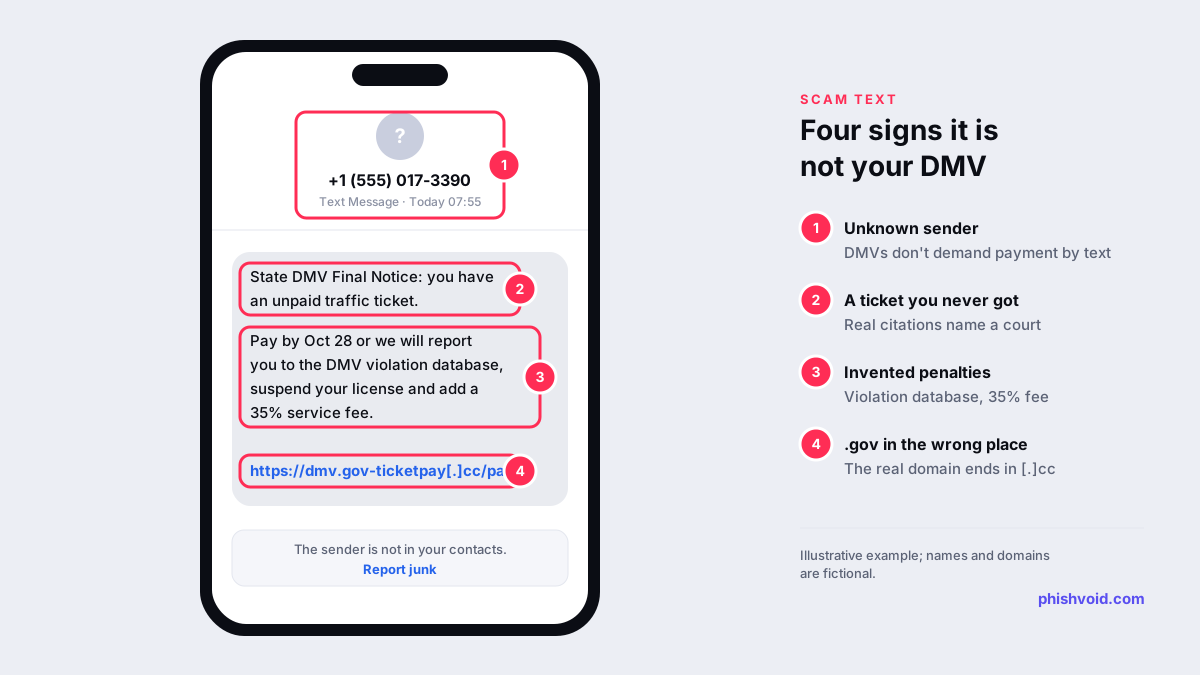
The Federal Trade Commission described the pattern in its alert That text about an overdue traffic ticket is probably a scam. The texts look like they come from your state's DMV and claim you have an overdue traffic ticket. They include a payment link and warn that if you don't pay right away you will be reported to a "DMV violation database", your registration, license and driving privileges will be suspended, and a 35% service fee will be added. Some go further and threaten prosecution or damage to your credit score.
The scam has kept going into 2026. North Carolina's Attorney General issued a consumer alert about DMV text scams in May 2026, describing texts about unpaid traffic citations that threaten license suspension or registration cancellation, and stating that state agencies will never text you and demand payment.
REAL ID and other DMV themes
Ticket texts aren't the only version. The FTC has also warned about texts and emails pretending to be from the DMV or the Department of Homeland Security that offer to let you jump the line for a REAL ID if you click, share your information and pay. In its alert Yes, going to the DMV is the only way to avoid a REAL ID scam, the FTC says the only way to get a REAL ID is to visit your state DMV in person and that nobody can speed up the process for you. Any text offering a paid shortcut is a scam.
The same playbook appears with other motor vehicle themes, such as renewal deadlines, inspection notices or a "final notice" about registration. The test is the same for all of them: the message wants you to act through its own link, right now.
Why the threats don't add up
- The DMV may not even handle tickets. The Alaska DMV says plainly that it does not collect payments for traffic tickets. A genuine citation names the court or agency that issued it, and you pay or contest it there.
- Suspension doesn't happen by text. A real license or registration action follows a legal process, not a text with a same-day deadline.
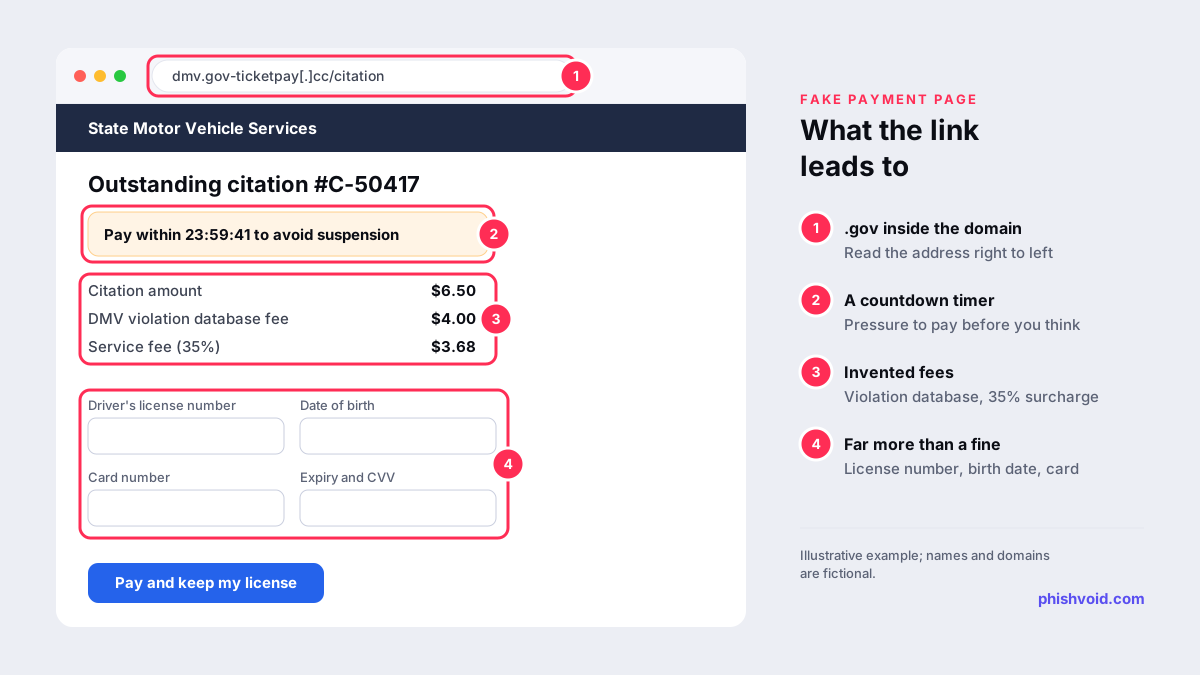
- The penalties are invented. A "DMV violation database", a 35% service fee and credit score damage from the DMV are features of the scam, as the FTC's alert describes.
- The sender is wrong. The Alaska DMV notes that it doesn't send texts from international or out-of-country area codes. Scam texts often come from random numbers or email addresses.
- The link isn't a state website. State DMV sites usually end in
.gov. Scammers often put ".gov" or "dmv" early in a long address so it looks official, while the real domain at the end is something else. Read the domain from right to left, as our guide to lookalike domains explains.
How to check whether you really owe a ticket
- Don't use anything in the text: not the link, not the phone number and not a QR code.
- Open your state DMV's website yourself. Search for your state's motor vehicle agency and confirm the address ends in
.gov, or use a bookmark or a letter you received by mail. - For a ticket, go to the issuing court or agency. If you were really cited, the citation names who issued it. Look that court or agency up yourself and check by citation number or license number.
- Or call. Use a phone number from the official website. North Carolina's Attorney General, for example, tells residents who are unsure about a citation to contact the NCDMV directly at 919-715-7000.
- Check your license status online if your state offers it on its official site. If your license and registration are valid and no court has a record of a ticket, the text was a scam.
How to report a DMV text scam
- Forward the text to 7726 (SPAM) or use your phone's report junk option, then delete it. This is the FTC's advice in its traffic ticket alert.
- Report it to the FTC at ReportFraud.ftc.gov.
- Tell your state attorney general if your state collects these reports. North Carolina, for example, asks residents to report DMV scam texts at ncdoj.gov/complaint.
- File with the FBI's IC3 at ic3.gov if you lost money, including the sending number and the website address.
You usually don't need to report the text to the DMV itself. The Alaska DMV, for instance, says a scam text should be reported as spam and deleted. Check your own state's guidance. For other countries and other kinds of scams, see our guide on how to report a scam.
If you paid or gave your license number
- Call your bank or card issuer on the number on your card. Ask them to block the card and dispute the payment.
- If you entered your driver's license number, date of birth or Social Security number, get a recovery plan at IdentityTheft.gov. Those details can be used to open accounts in your name.
- Watch for follow-up contact. Scammers may call claiming to be your bank's fraud team or the DMV, offering a refund. Hang up and call the official number yourself.
Our I got phished page has a fuller checklist.
For state agencies and courts
Sending numbers change constantly, so blocking them one by one has limited effect. The fake payment sites are the part that can be removed. Agencies can publish the exact domains they use for payments, say clearly on their site that they don't collect fines by text, and report lookalike domains to the registrar, the host and browser blocklists as soon as they appear. Phishvoid does this work for organisations whose names are being copied, with a person verifying each site before it is reported.
FAQ
Does the DMV send text messages about tickets?
DMVs that have warned about this scam say they don't request payment by text, and some, such as Alaska's, don't collect traffic ticket payments at all. Treat any text demanding payment for a ticket as a scam and check with the issuing court yourself.
Can my license be suspended because I ignored a text?
No. Ignoring a scam text has no effect on your license. If you're worried, check your license status on your state DMV's official website.
What is the "DMV violation database"?
It is a threat used in the scam. The FTC lists being reported to a "DMV violation database" as one of the warnings these fake texts use to rush people into paying.
I clicked the link but didn't pay. Am I safe?
The risk is much lower if you entered nothing. Close the page, don't return to it and report the text. If you typed your license number or card details, follow the steps above.
Is someone impersonating your brand?
We find lookalike domains and cloned pages and take them down. Start with a free exposure scan.