Got an Evri text asking for a fee or a reply? See what genuine Evri texts look like, how to track a parcel safely and how to report a fake to 7726.
Quick answer: An Evri scam text is a fake delivery message that uses the courier's name to get you to tap a link, pay a small fee or enter your card details. Evri says its genuine texts come from the sender name "Evri", not a mobile number, never ask you to pay to reschedule a delivery, and never contain a link except a tracking link that starts with https://evri.link/. If a text breaks those rules, don't tap anything. Check your parcel in the Evri app or on evri.com, forward the text to 7726 and delete it.
The texts are sent by criminals who borrow Evri's name, as they do with every large carrier. This guide covers the Evri version: what Evri says its real messages look like, how to check a delivery yourself and where to report a fake. For how fake delivery pages work in general, see our guide to fake parcel-delivery SMS scams.
What an Evri scam text usually says
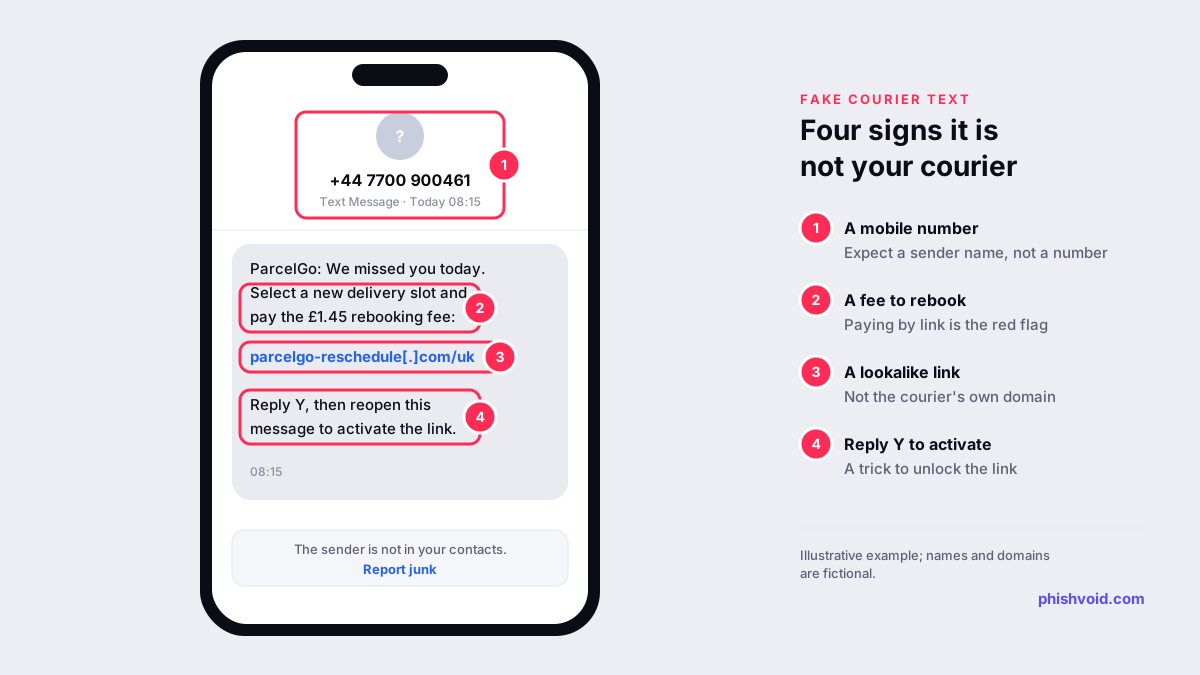
The wording changes often, but most fake Evri texts use one of a few stories:
- A missed delivery. "We missed you today" or "select a new slot", with a link to rebook.
- A small fee. A rebooking, redelivery or "shipping" charge of a pound or two. The fee is small so you don't think twice, but the goal is your full card details.
- Missing details. Your address or shipping information is "incomplete" and the parcel will be returned unless you update it.
- "Reply Y to activate the link". Evri warns on its fraud guidance page that scammers use this to get you to "accept" the sender as genuine, so the link can be opened directly. Evri says this disables a protection added by your mobile phone provider.
Many fake texts arrive through iMessage or RCS rather than plain SMS, sometimes from an email address or a foreign number. In a May 2024 warning, Evri explained that these services bypass the defences its partners use to flag malicious links in ordinary text messages.
What genuine Evri texts and emails look like
Evri publishes what its own messages do and don't do on its fraud guidance page and in its FAQ Is this Evri text/email genuine?. In short, according to Evri:
- Texts come from "Evri", not from a mobile phone number.
- The only link is a tracking link. Evri says its texts never include a link except a tracking link in the form
https://evri.link/.... Even then, it says it can't guarantee that a link in this format is genuine, so if you are unsure, don't click and track the parcel on its website instead. - No payment to reschedule. Evri says it will never ask you to reschedule a delivery or pay to do so by text.
- No app installs. It says it will never prompt you to install an app.
- Genuine emails typically come from addresses ending in @evri.com, @hermes-europe.co.uk or @myhermes.co.uk.
- Three delivery attempts. Evri says it attempts all deliveries up to three times, so one missed delivery doesn't mean your parcel is about to be returned.
One detail can cause confusion: Evri says it may contact customers about an ongoing claim and ask them to reply "yes" or use response buttons to confirm a parcel's status. If you haven't made a claim, a request to reply is a reason for suspicion, not reassurance.
How to check your Evri parcel without the link
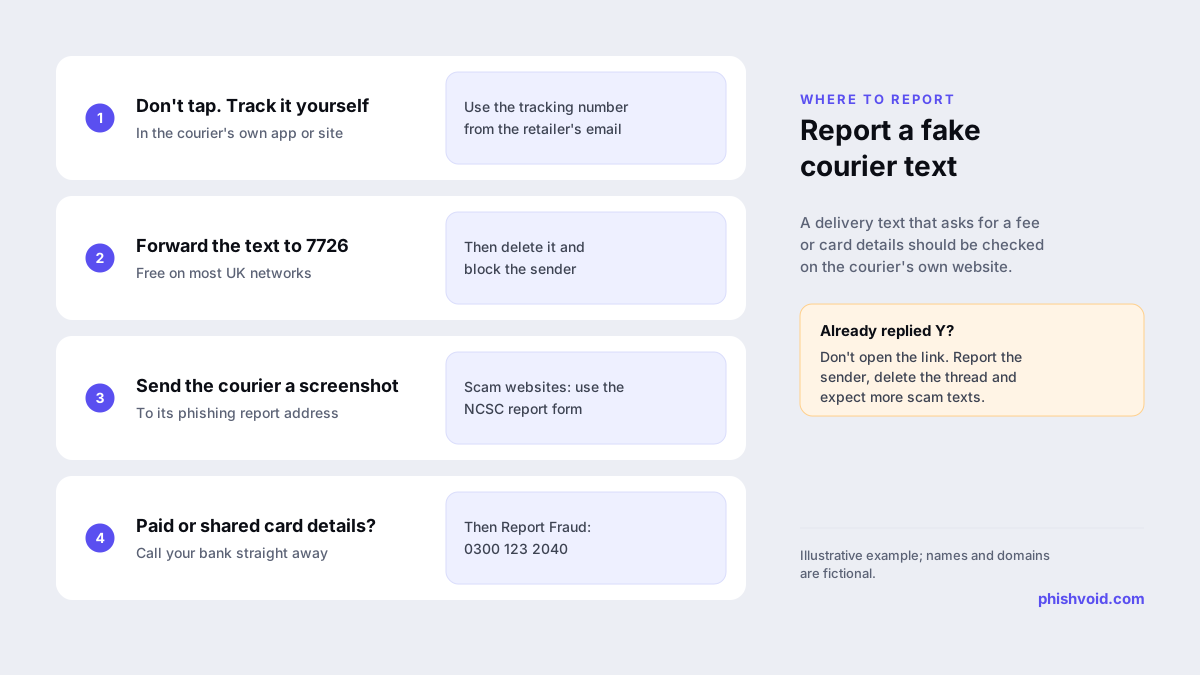
- Leave the message alone. Don't tap the link, call any number in it or reply.
- Find your own tracking number. It is in the order confirmation or dispatch email from the shop you bought from, not in the text.
- Track it yourself. Open the Evri app or type evri.com into your browser, and enter the number there. Check that the address bar really shows evri.com before you type anything.
- Ask the retailer if the tracking page shows nothing, or if you are not expecting a parcel at all.
If the parcel exists and has a real problem, the official tracking page will show it. If you want to see where a link really goes without opening it, our link checker can break it down.
How to report an Evri scam text
- Forward the text to 7726. Most UK mobile providers accept spam reports on this free number. The National Cyber Security Centre explains how to forward a text to 7726 on iPhone and Android.
- Tell Evri. Evri's fraud guidance page asks people to send a screenshot or photo of a suspicious text, or forward a suspicious email, to
phishing@hermes-europe.co.uk. Evri says it can't stop fraudulent messages being sent, but it investigates reports and works with partners to get fake sites taken down. - Report the fake website. Send the link to the NCSC through its scam website reporting form. Scam emails can be forwarded to
report@phishing.gov.uk. - Delete the text and block the sender once you have reported it.
If you lost money, also report it to Report Fraud at reportfraud.police.uk or on 0300 123 2040 (England, Wales and Northern Ireland). In Scotland, call Police Scotland on 101. Our guide on how to report a scam covers other countries.
If you tapped the link or paid the fee
- You only opened the page. Close it and don't go back. Clear the page from your browser history so you don't open it again by accident.
- You entered card details or paid the fee. Call your bank or card provider straight away on the number on your card. Evri gives the same advice. Ask them to block the card and watch for further payments.
- You entered a password. Change it everywhere you use it and turn on two-step verification.
- Expect a follow-up call. Criminals who have your card details often call next, pretending to be your bank's fraud team, and ask you to move money to a "safe account". Hang up and call your bank yourself. Our guide to the bank fraud text scam explains how that call works.
Evri also points victims of crime to Victim Support, which offers free, confidential help. Our I got phished page has a fuller checklist.
For retailers who ship with a courier
Fake courier texts often arrive while a customer is waiting for a real order, so many people contact the shop first. Say in your dispatch emails which courier you use and that neither you nor the courier will ask for a fee by text. Give support staff the reporting steps above. If the scam pages start using your shop's name next to the courier's, treat them as brand impersonation and report the domains to registrars, hosts and browser blocklists. Phishvoid finds and takes down lookalike delivery and payment pages like these, with a person verifying each site before it is reported.
FAQ
Does Evri send text messages?
Yes. Evri says genuine texts come from the sender name "Evri", not a mobile number, and contain no link other than a tracking link in the form https://evri.link/. If in doubt, track the parcel on evri.com instead.
Does Evri charge a redelivery fee by text?
Evri says it will never ask you to reschedule a delivery or pay to do so by text. A text that asks for a fee before a parcel can be delivered should be treated as a scam.
Where do I report a fake Evri text?
Forward it to 7726, and send a screenshot to Evri at phishing@hermes-europe.co.uk, as Evri's fraud guidance asks. If you lost money, call your bank and report it to Report Fraud.
I replied Y to an Evri scam text. What now?
Don't open the link. Replying can make the link clickable and confirms your number is active, so expect more scam texts. Report the message to 7726, delete it and block the sender.
Is a link that starts with evri.link always genuine?
Not necessarily. Evri itself says it can't guarantee that a link in this format is genuine. The safest route is to open the Evri app or type evri.com yourself.
Is someone impersonating your brand?
We find lookalike domains and cloned pages and take them down. Start with a free exposure scan.