Got a text offering a remote job with daily pay? It is probably a scam. Learn the red flags, how to check the recruiter and what to do if you replied or paid.
Quick answer: An unexpected text offering you a job, especially a vague remote role with daily or weekly pay that asks you to reply "YES" or to continue on WhatsApp or Telegram, is almost certainly a scam. In April 2026 the US Federal Trade Commission warned that that job offer text is probably a scam, and that real employers don't recruit this way. Don't reply. If the company named in the text interests you, find its official careers page yourself. Report the text by forwarding it to 7726, and never pay anything to get a job or to get paid.
This guide is for job seekers: what these texts look like, what happens if you reply, how to check whether an offer is real and what to do if you already replied, paid or shared your details. If you are an employer whose name is being used, read our guide to recruitment fraud impersonating your company instead.
What a fake job offer text looks like
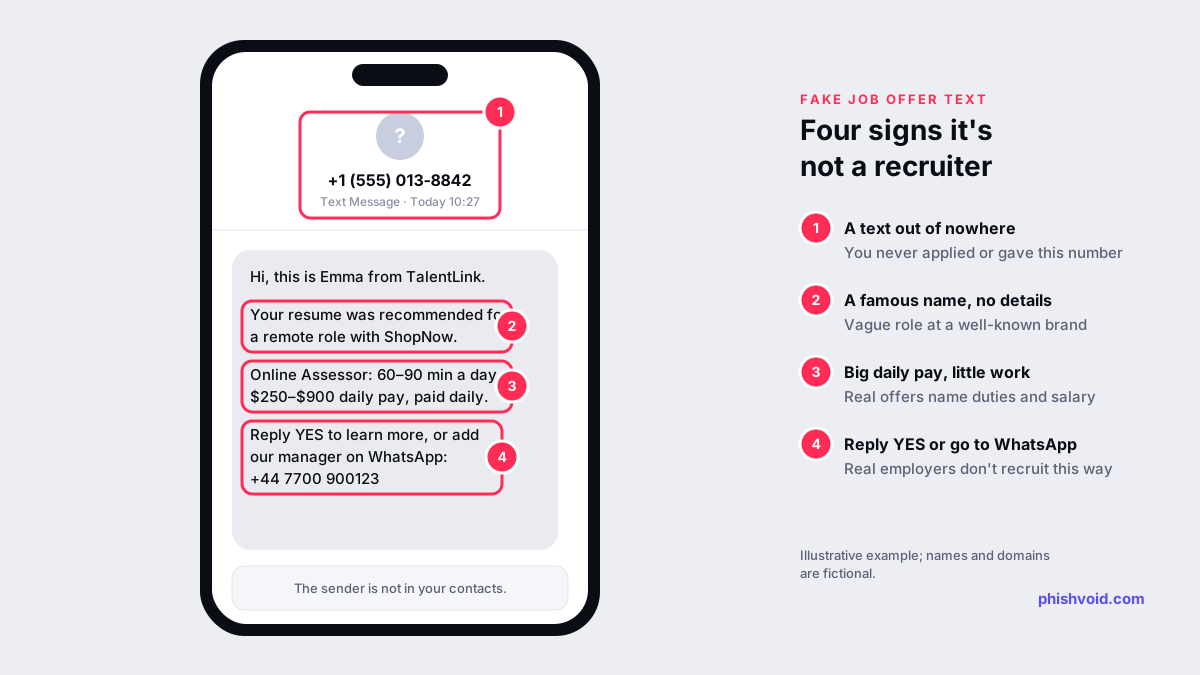
The FTC says these texts come from fake recruiters claiming to work for real companies. They advertise remote jobs such as "online assessor" or a generic "remote position", mention pay, sometimes daily or weekly, and give no real detail about the work. Instead of a link, they ask you to reply "YES" or "INTERESTED". The FTC's advice is not to reply, however professional the message looks.
Many versions add flattery ("your resume was recommended"), a well-known brand name, a short daily time commitment and a request to move the conversation to WhatsApp or Telegram. The FTC advises ignoring unexpected job messages on those apps too, because real employers don't recruit that way. Texts like these are a form of smishing, phishing by text message.
What happens if you reply
Replying tells the scammer your number is live and that you are interested. From there, the FTC describes two main routes, and both end with you sending money:
- The task scam. You are given simple online "tasks", such as liking videos or rating products, in an app that shows commissions building up. Early small payouts build trust. Then you are told to deposit your own money, often in cryptocurrency, to unlock more tasks or withdraw your earnings, and the money is gone. The FTC's data on task scams found that about 20,000 people reported them in the first half of 2024, against about 5,000 in all of 2023.
- The fake cheque. You receive a cheque to buy equipment or supplies and are told to send part of the money on. The cheque later bounces and you owe the bank what you sent.
- The identity grab. A quick "onboarding" asks for your Social Security or National Insurance number, a photo of your ID and your bank details for payroll. These can be used to open accounts in your name.
Job scams are not small. The FBI's 2025 Internet Crime Report lists 24,688 employment fraud complaints with about $363 million in reported losses.
How to check whether a job offer is real
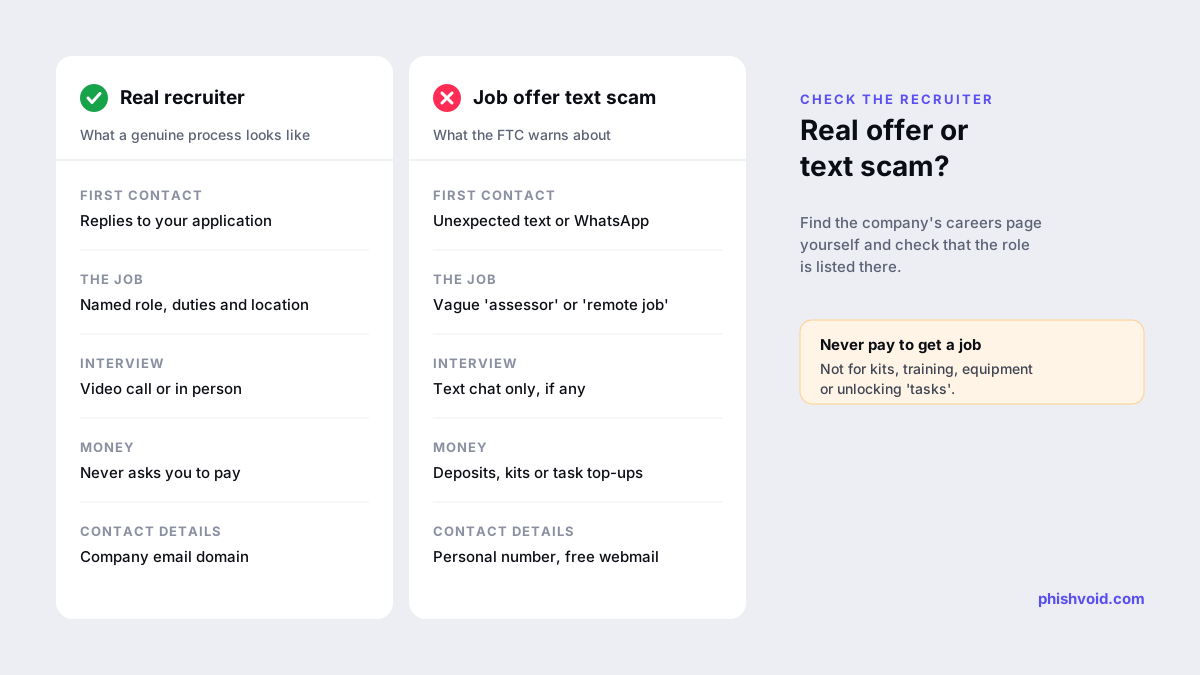
- Ask yourself whether you applied. A real recruiter contacting you out of the blue usually found you through a profile or an application, and will say which one.
- Find the company yourself. Search for its official website, open the careers page and check whether the role is listed there. Don't use links, phone numbers or names from the text.
- Contact the company through official channels and ask whether the recruiter works for it. Many companies publish a recruitment fraud warning on their careers page.
- Look for real job details: a named role, duties, location, salary range and a hiring process with people you can see and talk to.
- Search the recruiter's name and number with words like "scam" or "complaint", as the FTC suggests in its guide to job scams.
- Check any link without opening it. If the text includes a link, paste it into our link checker rather than tapping it, and read our guide to phishing links and texts.
The firmest rule of all comes from the FTC: never pay to get a job, and never pay to get paid. That includes starter kits, training, equipment, "deposits" and topping up a task account.
If you replied, paid or shared details
- You only replied: stop responding and block the number. Expect more texts, including "follow-ups" from new numbers.
- You sent money: contact the company you used to pay, such as your bank, card issuer, payment app, wire service or crypto exchange, straight away. Report the fraud and ask for the transaction to be reversed. The FTC's guide What To Do if You Were Scammed covers each payment method.
- You deposited a cheque: don't spend or forward the money, and tell your bank.
- You shared ID or bank details: tell your bank, watch your accounts, and in the US get a recovery plan at IdentityTheft.gov.
- Beware of recovery offers. People who promise to get your money back for a fee are often part of the same scheme.
Being caught by a job scam is common and nothing to be ashamed of. Our I got phished page has a fuller checklist for the first hours.
Where to report a fake job offer text
In the United States
- Forward the text to 7726 (SPAM) or use your phone's "report junk" option, then delete it.
- Report it to the FTC at ReportFraud.ftc.gov, and to your state attorney general, as the FTC recommends.
- If you lost money, also file at ic3.gov.
In the United Kingdom
- Forward the text to 7726, which is free and reports it to your mobile provider, as GOV.UK explains.
- If you lost money, report it to Report Fraud online or on 0300 123 2040, or to Police Scotland if you live in Scotland.
If the text uses a real company's name, tell that company too. Its fraud team can warn other candidates and have fake job sites taken down; Phishvoid does this work for employers whose brands are being used in recruitment scams.
FAQ
Do real recruiters text job offers?
Some recruiters do text candidates they are already in contact with, but the FTC says unexpected or generic job texts, WhatsApp or Telegram messages are a sign of a scam. A genuine recruiter can be confirmed through the company's official website.
What happens if I reply YES to a job scam text?
The scammer learns your number is active and starts the pitch, usually a task scam or a fake cheque. Stop replying, block the number and report it. Replying alone doesn't cost you money.
Why do job scams ask me to pay to get paid?
Because that is the scam. Task scams show fake earnings and then ask for a deposit to withdraw them. Real employers pay you; they never ask you to pay them.
How do scammers get my number?
Many texts are sent in bulk to large lists of numbers, so receiving one doesn't mean anyone has studied you. That is also why the message is so vague about the job.
Is someone impersonating your brand?
We find lookalike domains and cloned pages and take them down. Start with a free exposure scan.