How to get a domain back from a cybersquatter: recover a lapsed name, negotiate safely, or use UDRP, URS or a US ACPA lawsuit, and what each route returns.
Quick answer: How you get a domain back from a cybersquatter depends on how you lost it. If your own registration simply expired, contact your registrar at once: ICANN's rules leave a window to renew and, after deletion, a 30-day period to restore it. If someone else now holds a name that uses your trademark, you can negotiate a purchase, file a UDRP complaint to have it transferred to you, use the faster URS to have it suspended, or go to court, for example under the US Anticybersquatting Consumer Protection Act (ACPA). Only negotiation, a UDRP decision or a court order actually puts the domain in your hands.
Cybersquatting means registering or using a domain that matches someone else's trademark in bad faith. This article compares the routes by what each one really returns, what it costs and when it makes sense. It is general information, not legal advice; for a disputed domain of real value, involve trademark counsel early.
First, work out how you lost the domain
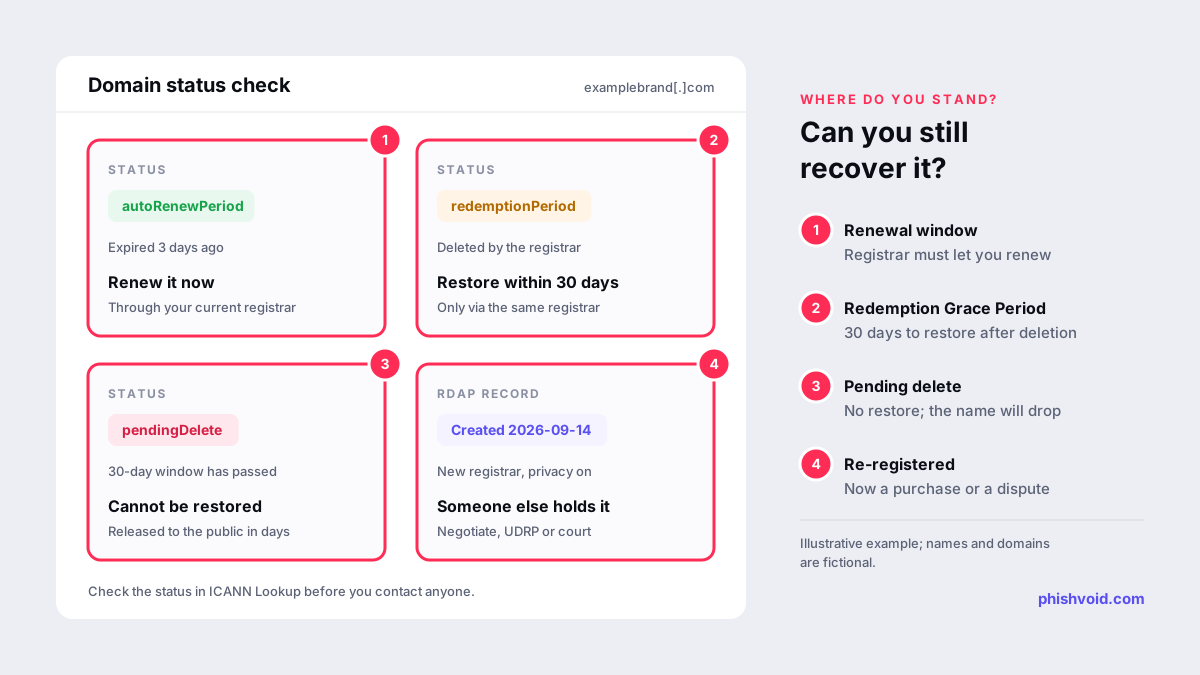
Look the domain up in ICANN Lookup and read three fields: the status codes, the creation date and the registrar. They tell you which situation you are in.
- It was yours and has just expired. Under ICANN's Expired Registration Recovery Policy, registrars send renewal reminders and must let the former registrant renew for a period after expiry. The registrar must also interrupt the website for part of that period, so a site going dark is often the first sign. If the registrar deletes the name, most gTLD registries then hold it in a 30-day Redemption Grace Period, during which only the original registrant can restore it, through the same registrar.
- It is in pendingDelete. ICANN's status code guide explains that this follows the 30-day redemption period. Restoration is no longer possible; within days the name is released and anyone can register it.
- Someone else registered it. A recent creation date and a new registrar mean the name dropped and was caught by another party. You now need one of the routes below.
- It was moved without your consent. That is a hijacking, not cybersquatting. Contact your registrar immediately; ICANN has a separate Transfer Dispute Resolution Policy for unauthorized transfers.
Route 1: Negotiate or buy it back
For a name with little legal case behind it, such as a generic word you never trademarked, buying is often the only realistic route. Even with a strong case, it can be faster than a dispute. A few precautions help:
- Reach the holder through the record. Most registrations are hidden behind privacy protection, but registrars usually offer a contact form or relay address. Our guide on how to find the owner of a website with privacy protection covers the options.
- Consider an intermediary. An approach from a well-known brand can raise the asking price. Use a broker and an escrow service for payment and transfer.
- Keep everything in writing. WIPO panels treat settlement discussions as admissible, and they can show whether the holder only wanted to profit from your mark (WIPO Overview 3.1, section 3.10). An offer to sell the name to you for more than its documented costs is one of the bad-faith examples in the UDRP itself.
- Weigh the precedent. Paying squatters can invite more squatting. Some brands buy only names that carry real traffic or email.
Route 2: UDRP, the standard way to get a transfer
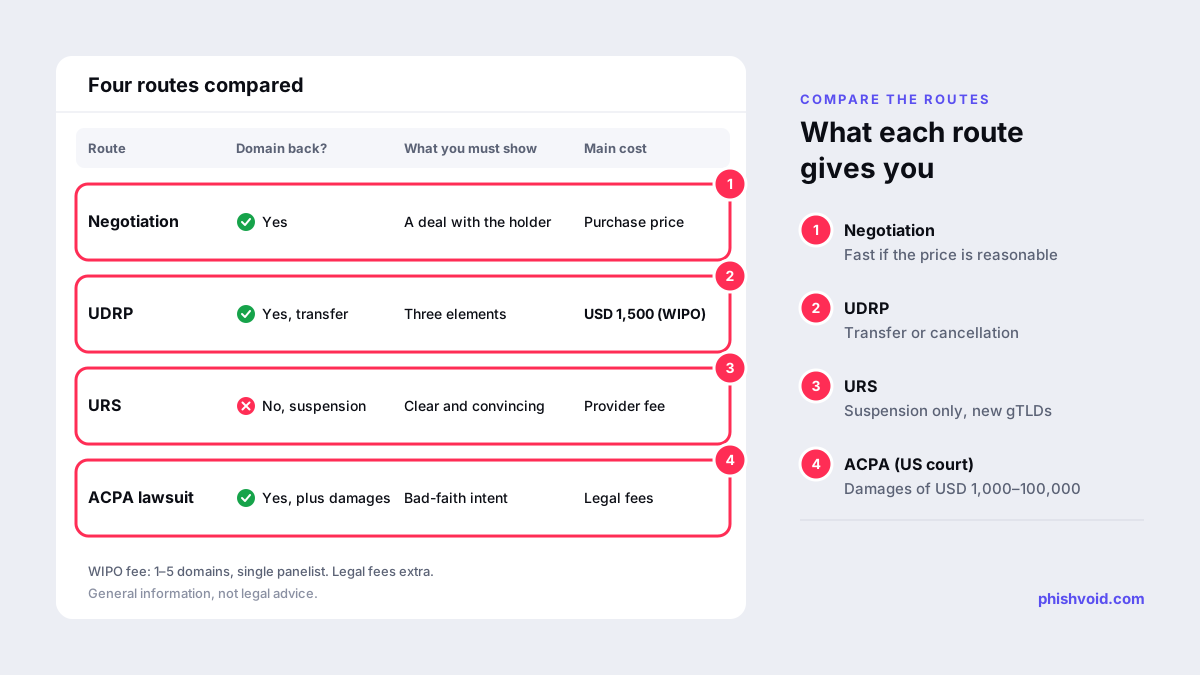
The UDRP covers all generic top-level domains and some country-code domains. You must prove three things: the domain is identical or confusingly similar to your mark, the holder has no rights or legitimate interests in it, and it was registered and is being used in bad faith (ICANN). A panel can order the domain transferred to you or cancelled.
At WIPO, the fee for one to five domains before a single panelist is USD 1,500, and cases are normally concluded within two months (WIPO). After a transfer order, the registrar waits ten business days before acting, in case the holder goes to court. Our step-by-step guide explains how to file a UDRP complaint.
One limit matters for lapsed domains: the UDRP protects trademarks, not former ownership. If the name is a plain word and you never had trademark rights in it, a complaint is unlikely to succeed.
Route 3: URS, fast suspension but no transfer
The Uniform Rapid Suspension System (URS) is a quicker procedure for clear-cut cases. According to ICANN, it applies to domains registered under ICANN's gTLD registry agreement, which includes all new gTLDs delegated after 2012, such as .shop or .online. The approved providers are ADNDRC, MFSD and FORUM.
- Higher bar: you must prove your case by clear and convincing evidence.
- Short timetable: the holder has 14 days to respond.
- Limited remedy: the domain is suspended for the rest of its registration period, which you can extend by one year at commercial rates. After that, it becomes available to anyone again.
The URS stops a domain from being used against you, but it does not give it back. Use it when you need a name switched off rather than owned.
Route 4: Court action, including the US ACPA
A court can give remedies that the dispute policies cannot. In the United States, the ACPA (15 U.S.C. § 1125(d)) makes a person liable who, with a bad-faith intent to profit from a mark, registers, traffics in or uses a domain that is identical or confusingly similar to a mark that was distinctive when the domain was registered. The court can order the domain forfeited, cancelled or transferred, and the trademark owner can elect statutory damages of USD 1,000 to 100,000 per domain name (15 U.S.C. § 1117(d)).
If the holder cannot be found or is outside the court's reach, the ACPA also allows an in rem action against the domain itself, filed where the registrar or registry is located. In that case the remedy is limited to forfeiture, cancellation or transfer. Other countries handle cybersquatting through their own trademark and unfair competition laws, and many country-code registries run their own dispute procedures. Court cases cost far more than a UDRP, so they are usually reserved for high-value names, repeat offenders or cases that also involve damages.
Which route to choose
- Your own domain, recently expired: your registrar, today. Every day counts once the redemption period runs.
- Brand name held by a squatter who asks for a price: compare the price with the cost of a UDRP. Keep the correspondence either way.
- Clear bad faith and you want the name: UDRP.
- Clear bad faith in a new gTLD and you just want it offline: URS.
- Repeat offender, high-value name or need for damages: court, with counsel.
- Domain used for phishing right now: report the abuse immediately, whatever route you choose for ownership. Registrars can suspend a domain used for phishing under ICANN's DNS abuse rules; see how to report domain abuse to a registrar.
A suspension and a transfer are not alternatives: a phishing domain can be suspended within days while a UDRP decides who owns it. Phishvoid handles that abuse side, with verified reports to registrars, hosts and blocklists, and can share the evidence with your counsel for the dispute.
FAQ
Can I get my expired domain back after someone else registered it?
Not through the registrar once it has been deleted and re-registered. You would need to buy it, or show trademark rights and bad faith in a UDRP complaint or a court case.
Is it cheaper to buy the domain or file a UDRP?
It depends on the asking price. A UDRP at WIPO costs USD 1,500 in fees for one to five domains with a single panelist, plus any legal fees, and the outcome is not guaranteed. A low price can be cheaper and faster.
Does a URS decision give me the domain?
No. The URS only suspends the domain for the rest of its registration period, with an optional one-year extension. After that it can be registered again by anyone.
Can I get damages from a cybersquatter?
Not through the UDRP or URS. In the United States, a court can award statutory damages of USD 1,000 to 100,000 per domain under the ACPA. This is not legal advice; ask counsel about your jurisdiction.
Is someone impersonating your brand?
We find lookalike domains and cloned pages and take them down. Start with a free exposure scan.