How to file a UDRP complaint: choose a provider, prove the three elements, draft and pay the WIPO fee, then follow each step from registrar lock to transfer.
Quick answer: To file a UDRP complaint, choose an ICANN-approved dispute resolution provider such as the WIPO Arbitration and Mediation Center, write a complaint that proves all three elements of the policy, attach your evidence, pay the provider's fee and submit everything electronically, with a copy to the domain's registrar. At WIPO, the fee for one to five domain names decided by a single panelist is USD 1,500, and a case is normally concluded within two months (WIPO).
The UDRP (Uniform Domain-Name Dispute-Resolution Policy) is the standard way to recover a domain that someone registered to exploit your trademark, a practice known as cybersquatting. This guide follows one complaint from the first check to the transfer, using WIPO's procedure as the example; other providers apply the same ICANN rules with their own supplemental rules and fees. It is general information, not legal advice, and many brand owners file through trademark counsel. If you are still deciding between a UDRP and a registrar suspension, read our guide to domain takedown options first.
Before you file: check that the UDRP fits
A complaint costs money and weeks of time, so confirm five things first:
- The extension is covered. The UDRP applies to all generic top-level domains such as .com or .shop. Some country-code domains use it or a local variant; WIPO keeps a list of the ccTLDs it serves.
- You have trademark rights. Registered and unregistered (common law) marks both count, and for this first test panels do not consider where the mark is protected (WIPO Overview 3.1, section 1.1).
- Your rights came first. If the domain was registered before your trademark rights existed, panels generally do not find bad-faith registration, apart from limited cases such as a registration timed to an announced merger or product launch (section 3.8).
- Transfer or cancellation is enough. The only remedies are transfer or cancellation of the domain. There are no monetary damages and no injunctions (WIPO).
- Nothing urgent is live. If the domain already hosts a phishing page, report it to the registrar, host and blocklists now. A UDRP decision takes weeks; the takedown process runs in parallel.
Step 1: Choose a provider and panel size
ICANN currently lists five approved UDRP providers: the Asian Domain Name Dispute Resolution Centre (ADNDRC), the Canadian International Internet Dispute Resolution Centre (CIIDRC), the Czech Arbitration Court's Arbitration Center for Internet Disputes, FORUM (formerly the National Arbitration Forum) and WIPO (ICANN). They differ in fees, supplemental rules and languages, so compare them before choosing.
You also choose between a single panelist and a three-member panel. A single panelist is cheaper and is the usual choice for clear cases. A three-member panel costs more and requires you to propose candidates. If you choose a single panelist, the respondent can still ask for three, and then shares the cost.
Step 2: Prove the three elements
Paragraph 4(a) of the policy requires you to prove all three of the following. Panels decide on the balance of probabilities, and unsupported claims are normally not enough (WIPO Overview 3.1, section 4.2).
- The domain is identical or confusingly similar to your mark. Panels compare the mark and the domain side by side and ask whether the mark is recognizable. Extra words such as "login" or "support" generally do not avoid similarity, common misspellings count, and the extension is ignored (sections 1.7 to 1.11). Evidence: registration certificates or proof of use.
- The registrant has no rights or legitimate interests. Show that you never licensed the name, that the registrant is not known by it, and that it is not used for a genuine business or fair use. You only need a reasonable first case; the burden then shifts to the respondent.
- It was registered and is being used in bad faith. Paragraph 4(b) gives examples: offering the domain for sale to you for more than its costs, a pattern of blocking registrations, disrupting a competitor, or attracting users for profit by confusion. Panels also treat phishing and fraudulent emails sent from the domain as bad faith (section 3.4), and can find bad faith in a domain that is not used at all (section 3.3).
Collect the evidence while it is still online: dated screenshots on desktop and mobile, the RDAP record, mail (MX) records, any sale offers and any phishing emails with full headers.
Step 3: Draft the complaint
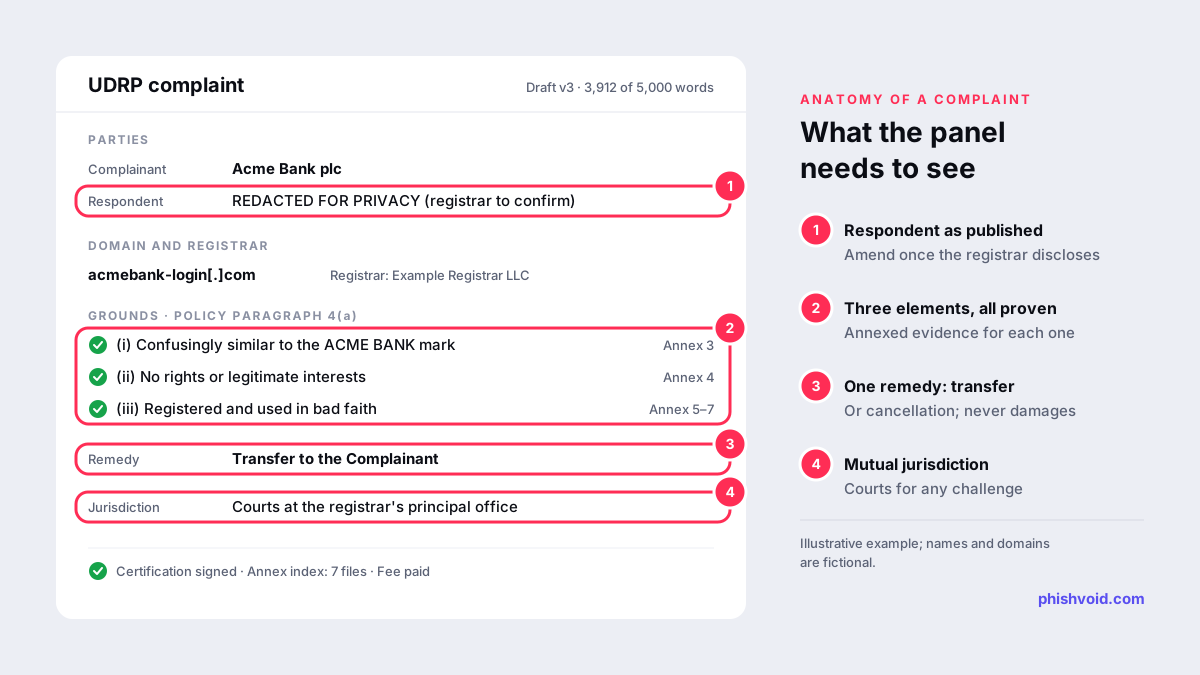
WIPO publishes a model complaint as a Word document and an online form. Its Supplemental Rules limit the written grounds to 5,000 words. The UDRP Rules require, among other things:
- your contact details and those of your representative;
- the respondent's name and every contact detail you know;
- the domain names, the registrar and the marks you rely on;
- your arguments on each of the three elements;
- the remedy you want: transfer or cancellation;
- any other legal proceedings about the domain;
- a mutual jurisdiction, meaning the courts you accept if the respondent challenges a decision against them;
- the signed certification and an indexed list of annexes.
If the registrant is hidden by privacy protection, name the respondent exactly as the public record shows it. WIPO asks the registrar to confirm the real registrant's details, and you can then amend the complaint, including the respondent and the mutual jurisdiction (WIPO). Several domains held by the same registrant can go into one complaint, which costs less than separate cases.
Step 4: Submit, pay and copy the registrar
At WIPO, send the complaint and annexes to domain.disputes@wipo.int or use the online form, pay the fee at the same time, and send a copy to the registrar (WIPO). WIPO does not proceed until the fee arrives. Payment goes through WIPO Pay, which needs a WIPO account.
WIPO's fee schedule for the UDRP:
| Domain names | Single panelist | Three panelists |
|---|---|---|
| 1 to 5 | USD 1,500 | USD 4,000 |
| 6 to 10 | USD 2,000 | USD 5,000 |
| More than 10 | Agreed with WIPO | Agreed with WIPO |
WIPO also offers expedited processing for USD 4,000, for up to five domains before a single panelist, aiming for a decision within one month of commencement. If you withdraw before the respondent is notified, WIPO keeps USD 100; after commencement but before a panelist is appointed, it keeps USD 500. Legal fees, if you use counsel, come on top.
What happens after you file
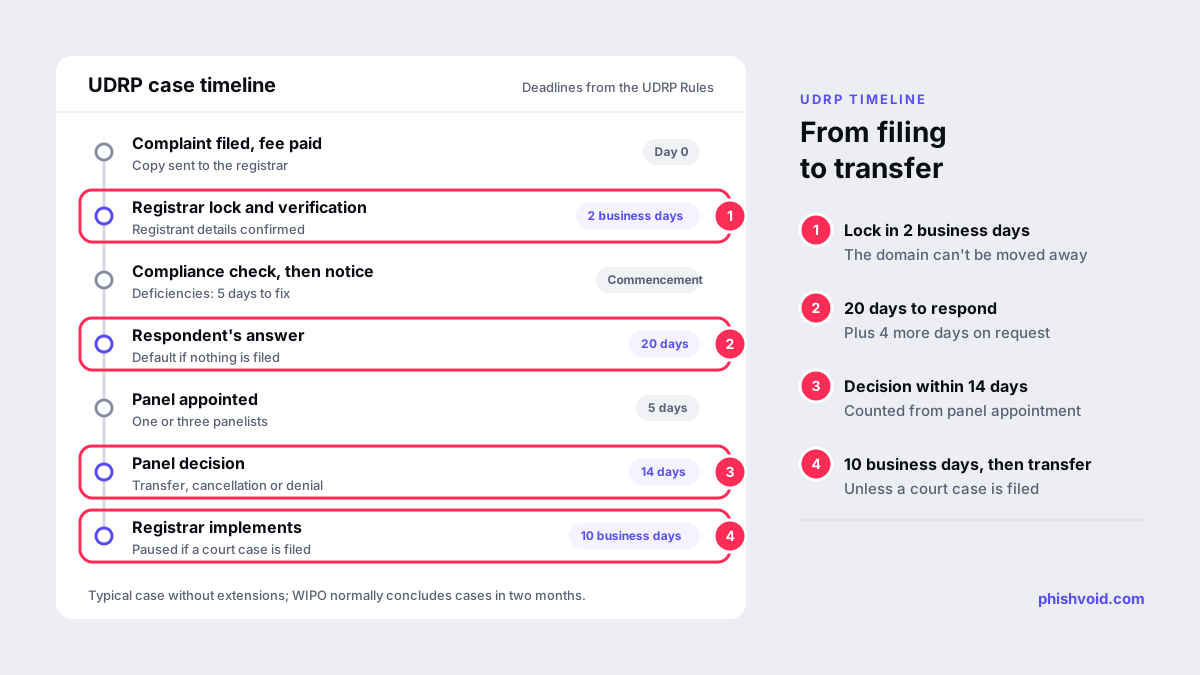
The UDRP Rules set the pace. In a typical case without extensions:
- Lock and verification. Within two business days of the provider's request, the registrar confirms the registrant's details and locks the domain so it cannot be moved.
- Compliance check. The provider reviews the complaint. If something is missing, you have five calendar days to fix it.
- Commencement. The provider notifies the respondent, and the case formally starts.
- Response. The respondent has 20 days to answer and can get four more days on request.
- Panel. A single panelist is normally appointed within five days after the response or the deadline.
- Decision. The panel decides within 14 days of appointment, and the provider sends the decision to the parties and the registrar.
- Implementation. The registrar waits ten business days. If the respondent files a court case in that window, the transfer is put on hold (policy, paragraph 4(k)).
Once the domain is transferred, renew it, point it at your main site or a parking page you control, and add it to your monitoring. If you lose, there is no appeal within the UDRP. Panels accept a refiled case only in exceptional circumstances (section 4.18), but either party can still go to court. A complaint brought in bad faith can also be declared reverse domain name hijacking, so file only when the three elements genuinely fit.
While the case runs, a lookalike domain can still send phishing email. Phishvoid can report that abuse to the registrar, host and blocklists during the dispute and share the evidence it collects with your counsel.
FAQ
Do I need a lawyer to file a UDRP complaint?
The rules do not require one, and WIPO's model complaint is designed to be completed by the parties. Trademark counsel can still help with the bad-faith argument, the choice of mutual jurisdiction and any court action that follows. This article is not legal advice.
How much does a UDRP complaint cost?
At WIPO, USD 1,500 for one to five domains with a single panelist and USD 4,000 with three panelists, according to WIPO's fee schedule. Other providers set their own fees, and legal costs are extra.
How long does a UDRP case take?
WIPO says cases are normally concluded within two months. After the decision, the registrar waits ten business days before transferring the domain.
Can I file a UDRP against a domain with privacy protection?
Yes. Name the respondent as shown in the public record. The registrar discloses the underlying registrant to the provider, and you can amend the complaint once you see those details.
Can a UDRP panel award damages?
No. The only remedies are transfer or cancellation of the domain. Damages require a court, for example under the US Anticybersquatting Consumer Protection Act.
Is someone impersonating your brand?
We find lookalike domains and cloned pages and take them down. Start with a free exposure scan.