When is a domain name trademark infringement? The tests panels and courts apply, uses that can be legitimate, the evidence to collect and what to do next.
Quick answer: A domain name is likely to infringe a trademark when it uses the mark, or something confusingly similar, in a way that misleads people about who is behind it or exploits the mark in bad faith. Simply containing a trademark is not enough: what matters is how the domain is used, whether the holder has a legitimate reason to use the name, and the holder's intent. Brand owners usually act through a UDRP complaint, a court case or, when the domain hosts phishing, an abuse takedown.
This article is for brand and legal teams who have found a domain containing their mark and need to judge whether it crosses the line before deciding what to do. It explains the tests that panels and courts apply, the uses that can be legitimate, and the evidence that decides most cases. It is general information, not legal advice.
Containing a trademark is not the same as infringing it
Many domains that include a brand name are lawful. A repair shop can describe the products it services, a critic can name the company being criticized, and an ordinary word can be both a trademark and a dictionary term. Trademark rights also differ by country and by the goods or services they cover.
Problems start when the domain creates a false impression of connection with the brand, or when the holder registered it to profit from the mark. That is the core of cybersquatting, and it is what the dispute procedures and anti-cybersquatting laws target.
Three ways the question gets decided
"Infringement" can mean different things depending on where you raise it:
| Forum | What must be shown | Possible outcome |
|---|---|---|
| UDRP panel | Confusing similarity, no rights or legitimate interests, and bad-faith registration and use | Transfer or cancellation of the domain |
| Trademark infringement claim in court | Use of the mark in trade that is likely to confuse consumers, under national law | Injunction, damages and other court remedies |
| US ACPA claim | Bad-faith intent to profit from a distinctive or famous mark, whatever the goods or services | Transfer, cancellation, statutory damages |
The UDRP is the most common route because it is fast, inexpensive and works across borders. Its standard is narrower than full trademark law: it is aimed at abusive registrations, not at every commercial dispute over a name. The US Anticybersquatting Consumer Protection Act (15 U.S.C. § 1125(d)) applies regardless of the parties' goods or services, and lists bad-faith factors such as offers to sell the domain for profit, false contact details and registering many domains that match others' marks.
Signs that a domain crosses the line
WIPO's summary of panel decisions, the WIPO Overview 3.1, shows how panels read these cases:
- The mark is recognizable in the domain. Adding words such as "login", "support" or a place name generally does not avoid confusing similarity, typos and lookalike characters count, and the extension is ignored (sections 1.7 to 1.11).
- The traffic is monetized through confusion. Attracting users for commercial gain by creating confusion with the mark is a bad-faith example in paragraph 4(b) of the policy, as in a parked page with ads for competitors.
- The domain is offered to you or your competitors. Registering a name mainly to sell it for more than its costs is another listed example.
- It sends phishing or fake invoices. Panels treat email scams and phishing from a domain as bad faith even when no website is shown (section 3.4).
- It sits unused, but the context is suspicious. Non-use does not prevent a finding of bad faith when the mark is distinctive, the holder hides its identity or gives false details, and no good-faith use is plausible (section 3.3).
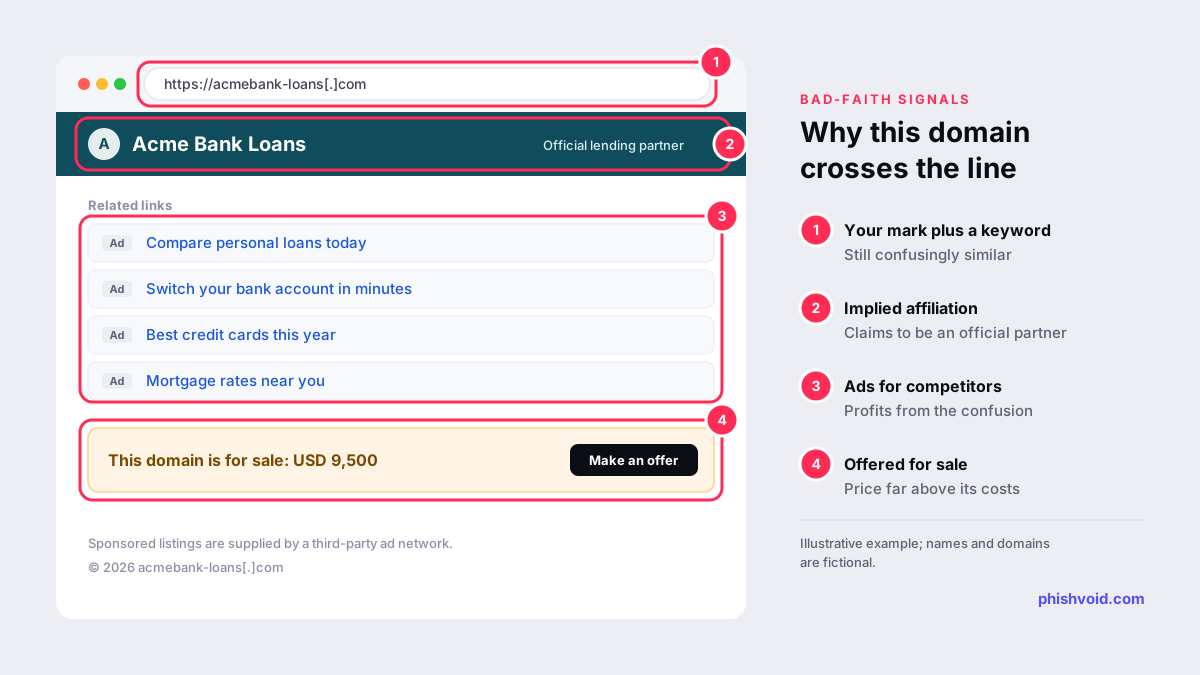
Some things do not count against the holder on their own. Using a privacy service is not bad faith by itself (section 3.6), and a disclaimer on the page cannot cure bad faith when the other circumstances point to it (section 3.7).
When a domain with your mark may be legitimate
Paragraph 4(c) of the UDRP lists three ways a holder can show a legitimate interest: a genuine offering of goods or services before any notice of the dispute, being commonly known by the name, or legitimate noncommercial or fair use without intent to mislead consumers or tarnish the mark. Panels have refined these:
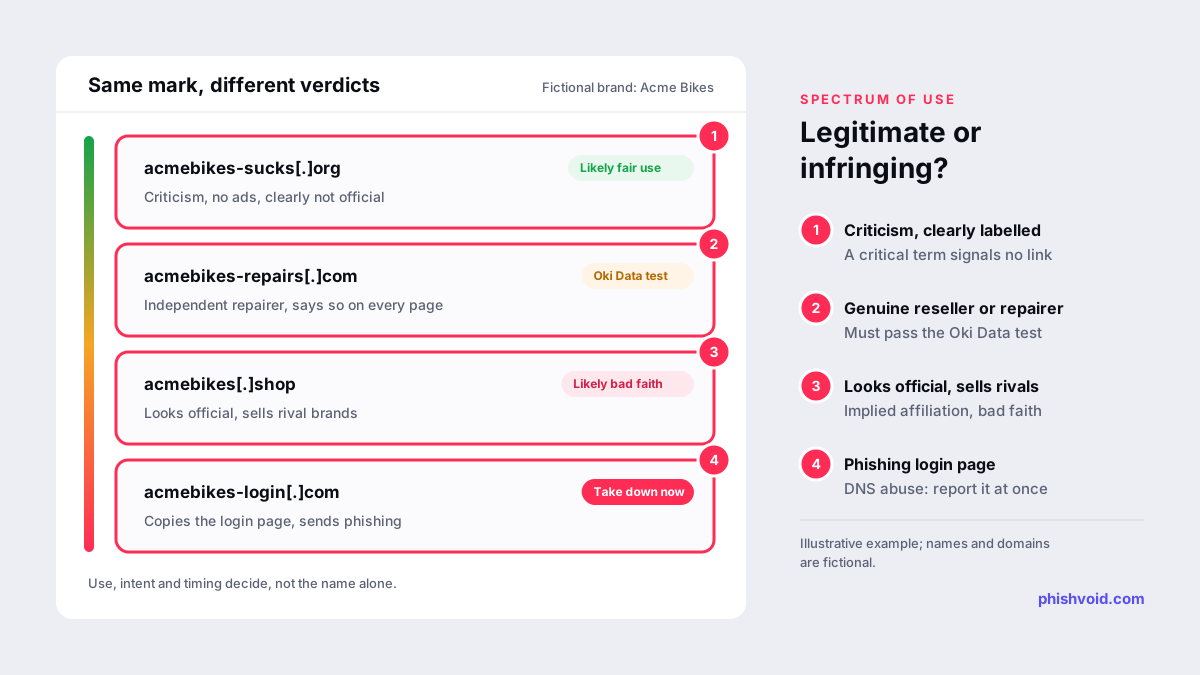
- Criticism and commentary. A critical term such as "sucks" signals that the site is not the brand's. A domain identical to the mark, by contrast, carries a high risk of implied affiliation even when the content is critical (section 2.5).
- Resellers and repairers. Under the "Oki Data" test, a reseller can have a legitimate interest if it actually offers the goods, sells only the trademarked goods, clearly discloses its relationship with the brand owner and does not try to corner the market in domains with the mark (section 2.8).
- Earlier registrations. If the domain was registered before your trademark rights existed, bad-faith registration is generally not found, except in limited cases such as registration timed to an announced merger, a publicized product launch or insider knowledge (section 3.8).
Build the evidence before you act
Panels decide on the written record, and unsupported allegations are normally not enough. A good file contains:
- Your trademark registrations, or evidence of use for unregistered marks, with dates.
- The RDAP record from ICANN Lookup: creation date, registrar and status.
- Dated screenshots of the site on desktop and mobile, including ads, sale notices and any copied content.
- Mail (MX) records and any phishing or invoice emails with full headers.
- Any correspondence with the holder, including price demands.
- Other domains held by the same party that target your mark or other brands.
To see how many variations of your brand are already registered, start with the lookalike domain finder, then review the matches in context.
What to do next
- Live phishing or malware: report it to the registrar, host and blocklists now. That is DNS abuse, and registrars are contractually required to act on well-evidenced reports. Phishvoid verifies such sites and runs these takedowns, which usually move much faster than a dispute.
- Parked, for sale or monetized through confusion: a UDRP complaint for transfer. See how to file a UDRP complaint.
- Clear-cut case in a new gTLD where you only need it offline: the faster URS, which suspends but does not transfer.
- Ambiguous use, or you need damages: talk to trademark counsel about a demand letter or court action. The routes are compared in how to get a domain back from a cybersquatter.
- Possibly legitimate use: monitor it. Filing a weak complaint risks a finding of reverse domain name hijacking.
FAQ
Is it illegal to register a domain with a trademark in it?
Not automatically. It becomes a problem when the domain is registered or used in bad faith or causes confusion about who is behind it. A genuine reseller, a critic or a business with its own rights in the name may be using it lawfully.
Does adding a word like "online" or "login" avoid infringement?
Generally not. WIPO panels find that adding descriptive or other words to a recognizable mark does not prevent confusing similarity. The added word may still matter when judging legitimate interest and bad faith.
Does a disclaimer on the site make it legal?
A clear disclaimer can support a holder who otherwise has a legitimate interest, such as an independent repairer. According to WIPO panel views, it cannot cure bad faith when the other circumstances point to it.
Can I get damages for a domain that infringes my trademark?
Not through the UDRP, which only transfers or cancels domains. Damages require a court; in the US, the ACPA allows statutory damages of USD 1,000 to 100,000 per domain name (15 U.S.C. § 1117(d)).
Is someone impersonating your brand?
We find lookalike domains and cloned pages and take them down. Start with a free exposure scan.