Brand protection for banks: which fake sites, ads, apps and accounts to monitor, how to get them removed and which controls make impersonation harder.
Quick answer: Brand protection for banks is the ongoing work of finding and removing the fake websites, lookalike domains, search ads, apps and social media accounts that use a bank's name to steal customer logins, card details and money. A working programme has three parts: continuous monitoring, fast and well-evidenced takedown requests to the parties that can act, and preventive controls that make the real bank easy to recognise.
Banks and payment companies remain among the most imitated brands online. The APWG counted 1,069,681 phishing attacks in the second quarter of 2026, and in the sector data it published from member Crane Authentication, financial institutions accounted for 11.4% of attacks and payment services for a further 13.2% (APWG Phishing Activity Trends Report, Q2 2026). This guide is for the fraud, security, legal and digital teams who have to turn that threat into a routine they can run every week.
What brand protection for banks has to cover
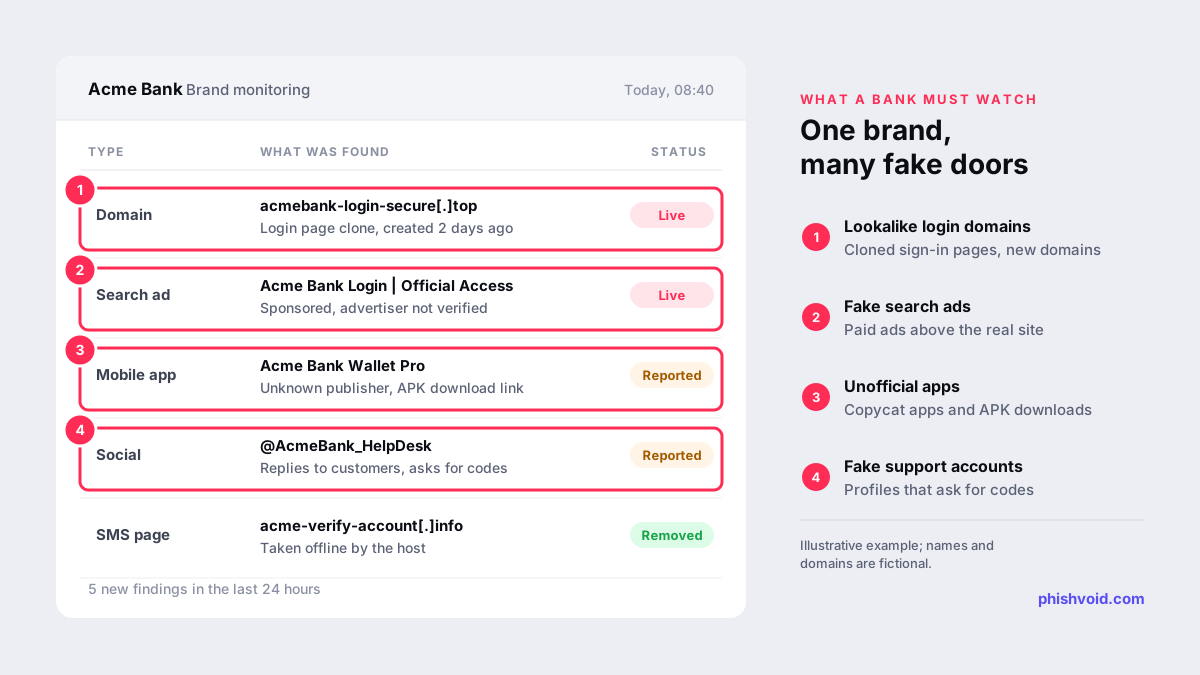
Scammers rarely stop at one fake website. A single campaign against a bank usually combines several channels, and each one needs its own detection and removal route:
- Lookalike domains and cloned login pages. Copies of the online banking sign-in page on domains such as
acmebank-login-secure[.]top, often built from a phishing kit and live for only a few days. - Smishing landing pages. Short-lived pages linked from text messages about blocked cards, failed payments or new payees.
- Paid search ads. Ads that appear above the real bank for searches like "acme bank login" and lead to a fake sign-in page. Our guide to fake bank ads on Google covers the reporting routes.
- Unofficial apps. Copycat apps in app stores, and APK files offered for download outside them.
- Fake support accounts. Social media and messaging profiles that answer customer complaints and then ask for one-time codes. See fake customer-support accounts.
- Spoofed email. Messages sent from, or made to look as if they come from, the bank's own domain.
- Fake loan and investment offers. Pages that borrow the bank's name to collect application fees or personal data.
Building the monitoring layer
You cannot remove what you have not found, and fake bank pages are often built to stay hidden from casual checks. Good coverage combines several sources rather than relying on a single feed.
Domains and certificates
Watch newly registered domains for your brand names, product names and common misspellings, and watch certificate transparency logs, the public records in which publicly trusted TLS certificates are logged. Both can give an early signal, sometimes before the fake page goes live. Our free lookalike domain finder shows the kinds of variants attackers register.
Search ads, app stores and social media
Search for your bank's name together with words like "login", "support" and "app" in each market you serve, on mobile as well as desktop, and check the advertiser names behind the ads. The Google Ads Transparency Center lets anyone search ads by advertiser or website. Check app stores for apps that use your name or logo from publishers you do not recognise, and check social platforms for new "help" or "support" accounts.
Reports from customers and staff
Customers who forward suspicious texts, contact centre agents who hear the same story twice in one morning, and fraud analysts who see a cluster of compromised accounts are often the fastest signal of all. Give them one internal address or form for suspicious links, and make sure someone triages it every day, including weekends.
Takedown: who can actually remove a fake bank site
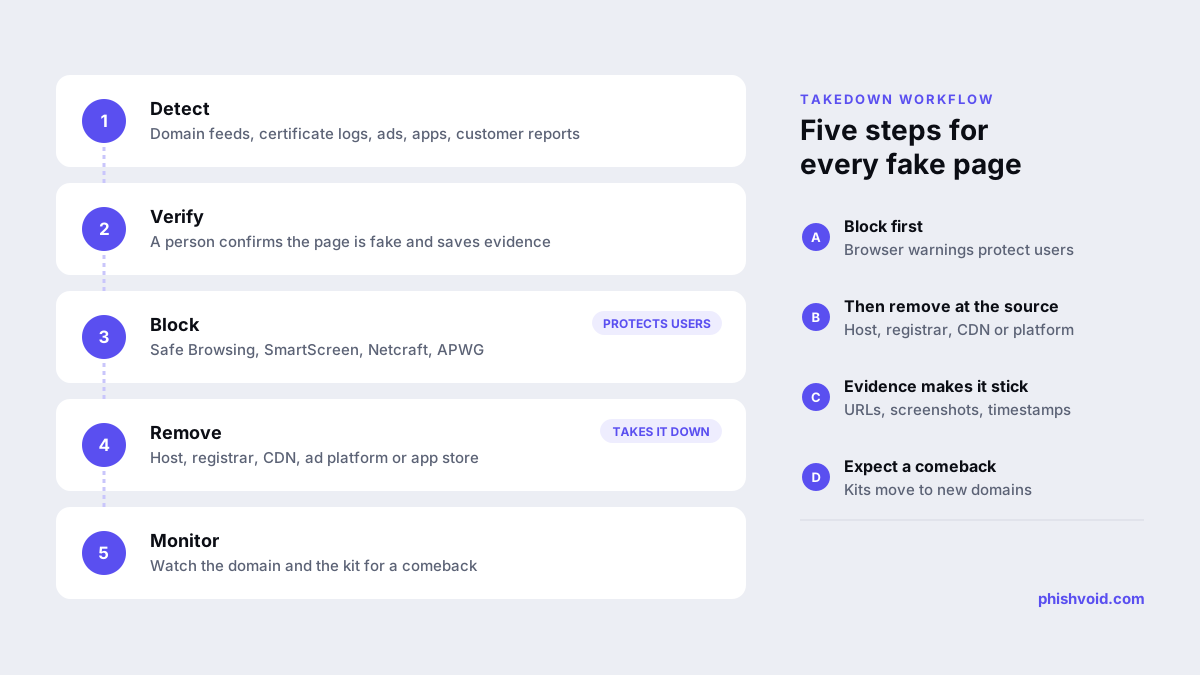
Once a person has confirmed that a page is fake and captured the evidence (the full URL, screenshots, timestamps and how it was found), reports should go to everyone who can reduce the harm. In practice that means several tracks running in parallel:
- Block in browsers and security tools. Reports to Google Safe Browsing, Microsoft SmartScreen, Netcraft and the APWG can lead to warnings being shown to customers even while the site is still online.
- Remove at the source. The hosting provider can take the page down, the registrar can suspend the domain, and a CDN such as Cloudflare can pass the report to the origin host. Ad platforms, app stores and social networks each remove content on their own services.
- Use national channels where they exist. In Türkiye, USOM accepts reports at siberguvenlik.gov.tr/ihbar; in the UK, the NCSC runs a suspicious website reporting service.
Reports from the bank or its authorised agent, backed by trademark details and a letter of authorisation, tend to carry more weight than anonymous flags, especially with ad platforms and app stores. Response times vary widely between providers, which is why follow-ups and escalation paths matter as much as the first report. The full sequence is described in the phishing site takedown process, step by step.
Preventive controls that make impersonation harder
Takedowns deal with the fakes that already exist. These measures reduce how well the next ones work:
- Enforce DMARC. A DMARC policy of quarantine or reject stops criminals from sending mail that passes as your exact domain. It does not stop lookalike domains, which is why monitoring still matters. See SPF, DKIM and DMARC.
- Publish your official channels. List your real domains, app names, social handles and phone numbers on one page, and link to it from your app and statements.
- Say clearly what you will never ask for. Decide which requests your bank will never make, such as asking for a PIN or a one-time code by phone, text or social media, and repeat that message often.
- Consider a verified domain. The .bank top-level domain is limited to verified, regulated banks and closely related organisations, so it gives customers a domain ending that criminals cannot simply register. It complements, rather than replaces, monitoring of your existing domains.
- Complete advertiser verification. Google requires advertisers of in-scope financial services to complete verification in 42 countries and regions, including the UK and Türkiye (Google Ads Help). A verified bank advertiser makes an unverified imitation easier to spot and report.
Who owns it inside the bank, and what to measure
Brand protection touches several teams, and the gaps between them are where fake pages survive. A simple split that works for many banks:
- Fraud and security operations triage reports, verify sites and link them to customer losses.
- Legal keeps trademark registrations and letters of authorisation current and approves escalations.
- Marketing and digital own the official ad accounts, app listings and social handles, and know which ones are real.
- Communications prepares customer warnings and answers press questions during a large campaign.
Track a small set of numbers every month: time from first sighting to verification, time to browser blocklisting, time to removal, the share of sites that return on a new domain, and the hosts and registrars that appear most often. Those numbers show where to escalate and whether the programme is improving.
Many banks keep detection in-house and outsource the reporting, because takedown work is repetitive and depends on knowing how each provider responds. Phishvoid does this as a managed service: our team verifies every site by hand, reports it to blocklists, hosts, registrars, CDNs and platforms under your authorisation, and follows up until it is gone, on one subscription with unlimited takedowns. Crypto platforms face a related but faster-moving version of the problem, covered in brand protection for crypto exchanges.
FAQ
What is brand protection for banks?
It is the monitoring and removal of fake websites, ads, apps and accounts that impersonate a bank, combined with controls such as DMARC and clear customer communication that make impersonation less effective.
How quickly can a fake bank website be taken down?
It depends on the hosting provider, the registrar, any CDN in front of the site and how complete the evidence is. Browser blocklisting can protect customers while removal is still in progress, so report on both tracks at once.
Does a bank need a registered trademark to get fake sites removed?
Not for phishing reports to hosts and blocklists, which act on fraud and abuse. Trademark registrations matter for ad platform, app store and some registrar complaints, which are often limited to rights holders or their authorised agents.
Should a bank warn customers about a specific fake site?
Usually yes, through the app, the website and social channels, without linking to the fake site. Tell customers how to recognise it and how to reach the bank safely.
Is brand protection the same as fraud prevention?
They overlap. Fraud prevention focuses on stopping suspicious transactions and account takeovers; brand protection removes the fake channels that feed them. Banks get the best results when both teams share data.
Is someone impersonating your brand?
We find lookalike domains and cloned pages and take them down. Start with a free exposure scan.