Digital risk protection vs brand protection: how the two differ in scope, owners and outcomes, where they overlap, and how to decide which one you need first.
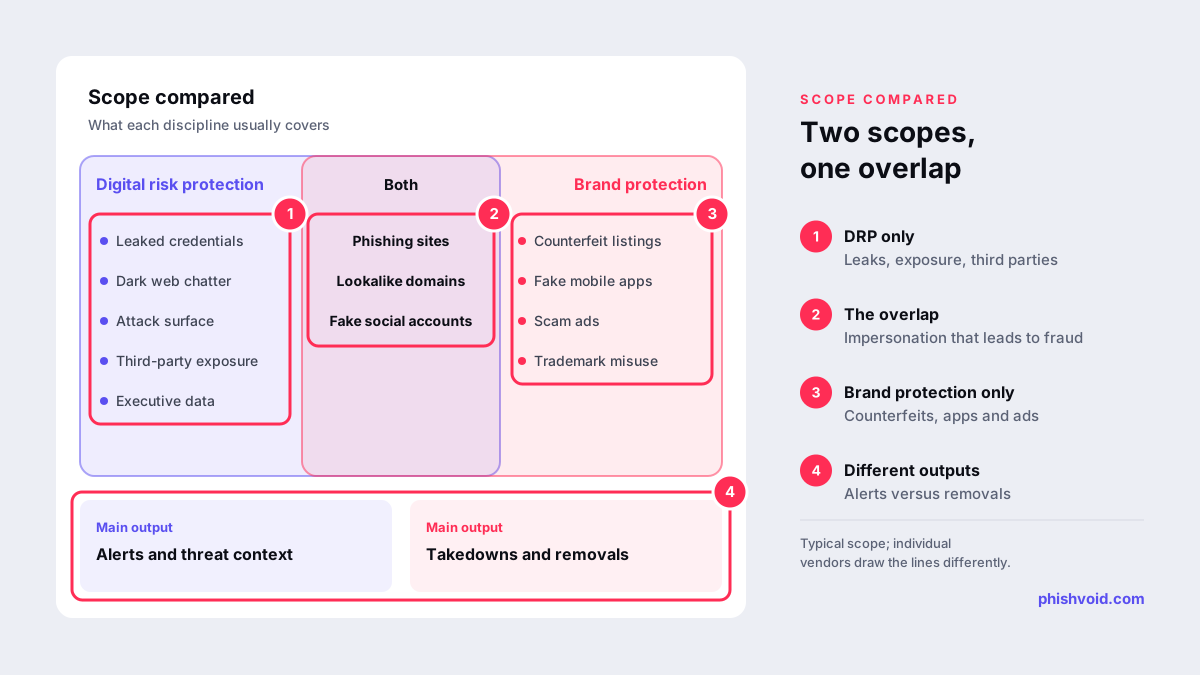
Quick answer: Digital risk protection (DRP) is the broader discipline. It watches the open web, social media, the deep web and the dark web for external threats to an organisation, including leaked data and credentials, exposed infrastructure, threats to executives and risks from suppliers. Brand protection is narrower and judged on outcomes: it finds and removes things that misuse your brand, such as phishing sites, lookalike domains, fake social accounts, counterfeit stores, fake apps and scam ads. The two overlap on impersonation. The practical difference is that DRP mostly produces intelligence, while brand protection is measured by removals.
Vendors use both labels loosely, so it helps to compare the work rather than the names. Analyst firm Gartner has covered digital risk protection services as a market for several years, for example in its Competitive Landscape: Digital Risk Protection Services, and many DRP platforms list brand protection as one module among several. Specialist providers, by contrast, often go deeper on enforcement in fewer channels. For what a brand protection provider typically includes, see our guide to brand protection services.
Digital risk protection vs brand protection at a glance
| Question | Digital risk protection | Brand protection |
|---|---|---|
| Main goal | See external threats early | Stop misuse of the brand and protect customers |
| Typical scope | Dark web, leaked credentials and data, attack surface, executives, third parties, plus impersonation | Phishing sites, lookalike domains, social media, marketplaces, app stores, ads |
| Main output | Alerts, threat context, risk scores | Takedowns, suspended domains, removed listings and accounts |
| Usual owner | Security or threat intelligence team | Security, fraud, legal or marketing, often shared |
| Measure of success | Coverage and relevance of alerts | Time to removal, and how many threats stay down |
| Common gap | Remediation left to the customer | Little visibility into criminal markets |
What digital risk protection covers
A DRP programme looks outward from the organisation and asks what an attacker could find, or already has. Common use cases include:
- Data and credential leaks: breach dumps, infostealer logs and leaked documents. Our guide to dark web monitoring for brands covers this in detail.
- External attack surface: forgotten subdomains, exposed services and certificates issued for your names.
- Executive exposure: leaked personal data, fake profiles and threats against leaders.
- Third-party risk: breaches and exposures at suppliers that hold your data.
- Impersonation: lookalike domains, phishing pages and fake social accounts, usually as one module among the others.
The strength of DRP is breadth and context. It can connect a leaked password, a newly registered domain and a forum post into one picture for the security team. Its common weakness is the last step. Many platforms raise an alert and offer a "request takedown" button, but the evidence gathering, reporting and follow-up behind that button vary widely between vendors and contracts.
What brand protection covers
Brand protection starts from the brand and asks where it is being misused in front of customers. It covers fake and cloned websites, typosquatting and other lookalike domains, impersonating social media pages and support accounts, counterfeit listings on marketplaces, fake mobile apps and scam ads that use your name or your executives' faces.
Its output is removal. That means verifying each case, collecting evidence and sending the right report to the right party: the hosting provider, the domain registrar, the CDN, the platform, browser blocklists such as Google Safe Browsing and Microsoft SmartScreen and, for copied content, DMCA notices. It also means checking whether the threat comes back on a new domain or host. A brand protection product that only alerts is closer to a monitoring tool; our comparison of brand protection software vs managed service explains that distinction.
Where they overlap, and where they don't
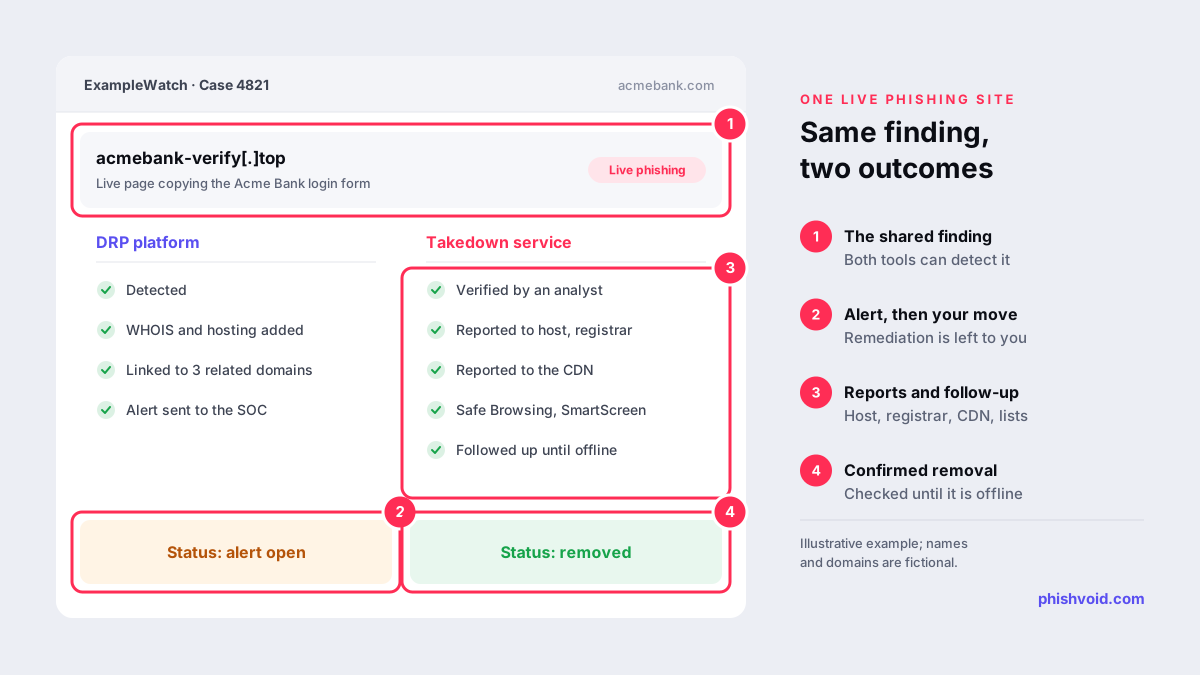
The overlap is impersonation that leads to fraud: phishing sites, lookalike domains and fake accounts. Both kinds of provider claim it, which is why comparisons get confusing. Ask a DRP vendor and a brand protection vendor what happens to one live phishing site, and the difference shows:
- A DRP platform will typically detect it, enrich it with domain and hosting data, link it to related infrastructure and alert the security team.
- A brand protection service will typically confirm it, file reports with the host, registrar, CDN and blocklists, chase the providers that do not reply, and confirm when the page is offline.
Outside the overlap, the differences are clearer. Brand protection services rarely cover infostealer logs or exposed servers. DRP platforms rarely handle counterfeit marketplace listings or trademark-based removals in depth.
Which one do you need first?
- Customers are being scammed by fake sites, ads or accounts: start with brand protection that includes takedowns. The harm is happening in public now, and speed matters most. Our article on how long it takes to take down a phishing site sets realistic expectations.
- Your security team lacks visibility into leaked credentials and exposed assets: start with DRP, or with a focused credential monitoring feed.
- You are a heavily targeted brand, such as a bank, exchange or large retailer: you will probably need both. A common setup is a DRP platform for intelligence, plus a managed takedown service that turns impersonation alerts into removals.
Whichever you choose, ask each vendor for figures from its own past work rather than general claims: median time to removal by channel, the share of cases that needed follow-up, and how reappearances are handled. Also check whether takedowns are included or billed per case, since that changes how freely your team will use them. Our brand protection RFP checklist lists questions you can copy.
If you already run a DRP platform, look at how its impersonation alerts are handled today. Someone has to decide whether each alert is a live phishing site, file the reports, chase the providers and record the result. When that work sits with an already busy security team, alerts tend to queue up. Passing confirmed impersonation cases to a dedicated takedown service keeps the intelligence where it is and adds the missing removal step.
Phishvoid works on the removal side. A human team verifies every site impersonating your brand and reports it to hosts, registrars, CDNs and blocklists, with unlimited takedowns under one subscription, and it can sit alongside a DRP platform you already use.
FAQ
Is brand protection part of digital risk protection?
Often, yes. Many DRP platforms include brand protection as a module, mainly for detecting impersonating domains and accounts. Dedicated brand protection services usually go further on enforcement and cover channels such as marketplaces and app stores in more depth.
Is digital risk protection the same as threat intelligence?
They overlap. Threat intelligence covers attackers and their methods broadly, while DRP focuses on external threats that concern your organisation specifically, such as your leaked data, your domains and your executives.
Do I need both DRP and brand protection?
Large and frequently impersonated organisations often do, because the two solve different problems. Smaller companies usually start with whichever matches their current harm: fraud against customers points to brand protection, while leaked credentials and exposed assets point to DRP.
What should a contract say about takedowns?
Check whether takedowns are included or charged per case, which channels are covered, who follows up with providers that do not respond, and how the provider reports time to removal and reappearances.
Is someone impersonating your brand?
We find lookalike domains and cloned pages and take them down. Start with a free exposure scan.