In-house vs outsourced phishing takedown: what running it yourself involves, signs it is time to outsource, a hybrid split and how to compare the cost.
Quick answer: Keep phishing takedown in-house when cases are few and predictable and someone on your team owns the work and knows the abuse ecosystem. Outsource it when volume spikes with campaigns, follow-up has to continue outside office hours, or nobody has the time to chase providers until sites are gone. Many organizations end up with a hybrid: they keep decisions, scope and customer communication, and hand verification, reporting and follow-up to a provider.
This guide is about the staffing decision: what running takedowns yourself really involves, the signals that it is time to outsource, and how to split the work. If you are comparing a detection platform with a managed service, see brand protection software vs managed service; for what a provider delivers, see phishing takedown service.
What running takedowns in-house actually involves
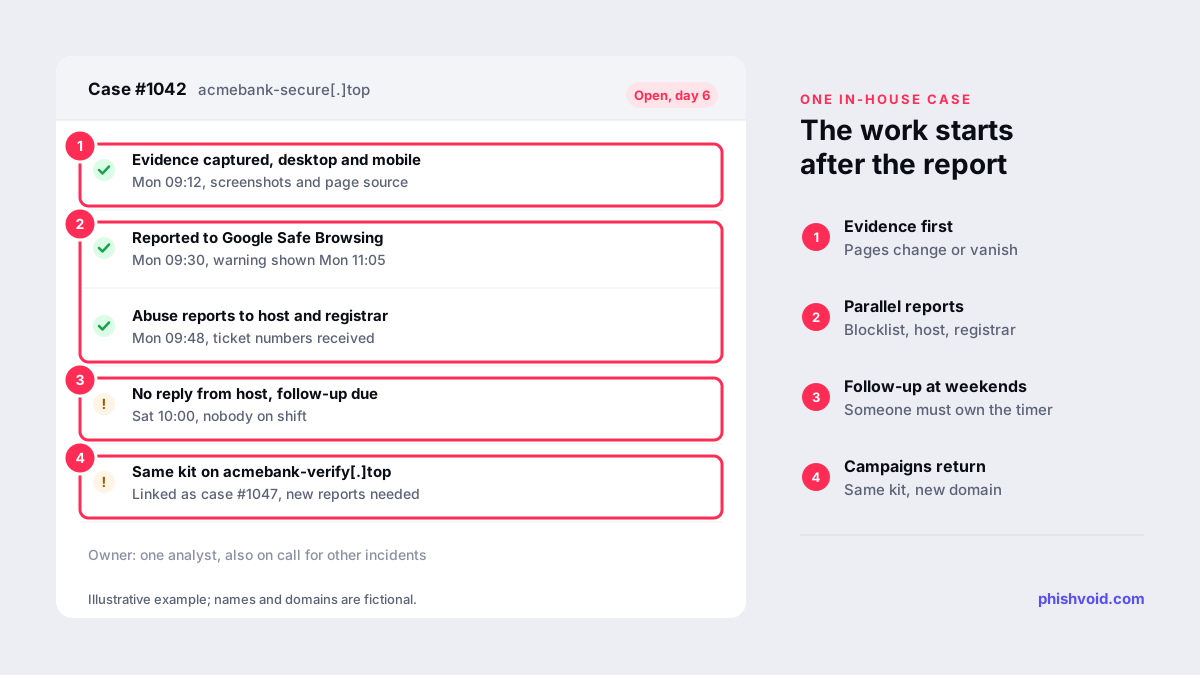
Sending one abuse report is easy. Running a takedown function is a set of capabilities that all have to be in place at once:
- Intake. One place where staff, customers and partners can send suspicious links, and someone who looks at it every day.
- Verification and evidence. Confirming a page is malicious and not a partner or reseller, and capturing it as victims see it, often from a phone or a specific country.
- A contact book. The right abuse form or address for each host, registrar, CDN, platform and national CERT you meet, kept up to date.
- Parallel reporting. Blocklists, host, registrar and CDN reported together, each with the evidence it asks for. Our phishing takedown notice template helps here.
- Follow-up and escalation. Chasing unanswered reports, including at night and at weekends, and escalating to upstream providers when needed.
- Campaign tracking. Linking new domains to earlier ones when the same kit comes back.
- Authority and records. Clear internal approval for reports sent in the company's name, and a case log that legal and fraud teams can use.
When in-house is the right call
An in-house function works well when most of these are true:
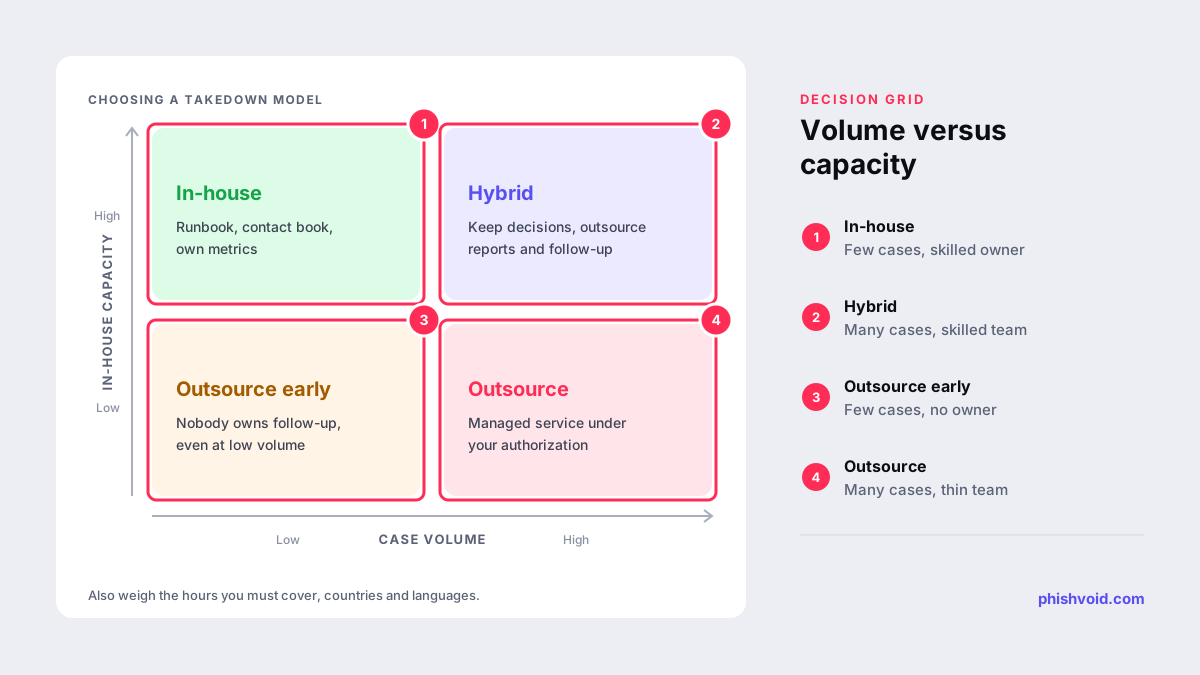
- You see a small, steady number of cases, not bursts of dozens in a week.
- A named person owns takedowns as part of their job, with cover for holidays.
- Your team already knows the main hosting providers and registrars and how their abuse desks respond.
- Your customers are concentrated in one or two countries and languages.
- Policy or regulation requires that every notice in your name is sent by your own staff.
To make it hold up, write a runbook, keep the contact book current and measure your own median time to blocklist and to removal. The step-by-step takedown process is a good starting point for the runbook.
When outsourcing makes more sense
The signals are usually operational rather than technical:
- Follow-up slips. Reports go out, but nobody has time to chase them, and sites stay up for days.
- Volume comes in waves. A campaign produces many domains at once, and the team falls behind other work.
- Hours do not match. Fake sites go live in the evening or at weekends, when your team is offline.
- Reach is wide. Cases involve providers in many countries, country-code registries and reports in several languages.
- Knowledge sits with one person. If they leave or go on holiday, the function stops.
Two or more of these together usually mean the question is capacity, not skill. Outsourcing moves the repetitive work to a team that does it all day, with established contacts at abuse desks. Phishvoid works this way: a human team verifies each site, reports it to blocklists, hosts, CDNs, registrars, search engines and platforms, and follows up until it is down.
The hybrid model: who keeps what
Outsourcing does not mean handing over every decision. A common split looks like this:
| Task | Keep in-house | Outsource |
|---|---|---|
| Defining scope: brands, domains, official accounts | Yes | Provider advises |
| Signing the authorization | Yes | No |
| Detection and intake | Internal reports | Monitoring and triage |
| Verification and evidence | Edge cases only | Yes |
| Reports, follow-up, escalation | No | Yes |
| Customer and staff communication | Yes | Provider supplies facts |
| Legal action, UDRP, law enforcement | Yes | Provider supplies evidence |
Whatever split you choose, write down who owns each case so the same site is not reported twice or missed. The provider will need a signed letter of authorization and a contact who can confirm quickly whether a domain is yours.
How to compare the cost fairly
In-house takedown looks free because the cost sits in salaries. A fair comparison counts:
- Staff time per case, timed from first report to confirmed removal on a few real cases, including follow-ups.
- Cover for evenings, weekends, holidays and sick leave.
- Tools for monitoring, evidence capture and case tracking.
- The cost of slow cases: support calls, reimbursements and fraud losses while a site stays live. Our article on the cost of brand impersonation lists these drivers.
Set that against a provider's quote for the same scope, and check the pricing model. Per-takedown fees can make a large campaign expensive, while an all-inclusive subscription keeps the cost flat.
Switching without losing ground
- Share your case history, contact book and list of known campaigns with the provider.
- Agree the definition of done, the metrics and the escalation path in writing.
- Run both in parallel for a few weeks, with the provider taking new cases and your team closing old ones.
- Keep a small internal skill: someone who can read the provider's reports, challenge them and handle sensitive cases.
Review the arrangement after the first quarter. Look at the median time to blocklist and to removal, the share of cases that needed escalation and how repeat campaigns were handled. If a site comes back, check that the provider linked it to the earlier case rather than starting from zero; our guide on phishing sites that come back after takedown explains why that matters.
FAQ
Is it cheaper to handle phishing takedowns in-house?
At low, steady volume it often is. As volume grows or cases need follow-up outside office hours, staff time and slow removals add up. Compare total cost, not just the provider's fee against zero.
Can a small team run phishing takedowns on its own?
Yes, if cases are few and someone owns the work. A runbook, a current contact book and a habit of reporting to blocklists, host and registrar in parallel cover most cases.
Do we lose control if we outsource takedowns?
Not if the contract keeps scope, authorization and edge-case decisions with you, and the provider shows evidence and timestamps for every case.
Should hacked legitimate sites be handled differently?
Yes. When a phishing page sits on a compromised small-business site, the goal is to get the owner or host to remove the page and fix the hole, not to suspend the domain. In-house teams and providers alike should note which kind of case they are handling.
Can we bring takedowns back in-house later?
Yes, if the contract lets you export the full case history and evidence. Keep one person internally who understands the process, so the knowledge is not lost.
Is someone impersonating your brand?
We find lookalike domains and cloned pages and take them down. Start with a free exposure scan.