Brand protection for logistics companies: the fake tracking pages, fee sites, driver jobs and freight emails to monitor, and how to get them taken down.
Quick answer: Brand protection for logistics companies means finding and removing the fake tracking pages, delivery-fee sites, lookalike domains, fake job adverts and spoofed freight emails that use a carrier's or forwarder's name, and making the genuine channels easy for customers and partners to recognize. The work has to cover both sides of the business: consumers who receive parcel texts, and the shippers, brokers and drivers who act on emails about loads and payments.
Logistics is a steady target. In APWG's Phishing Activity Trends Report for Q2 2026, logistics and shipping accounted for 9.6% of attacks in the sector breakdown supplied by APWG member Crane Authentication. This guide is for security, fraud and brand teams at parcel carriers, postal operators, freight forwarders, 3PLs and freight brokers. For the consumer side of parcel scams, see our explainer on fake parcel-delivery SMS and tracking pages; for choosing a provider in general, see brand protection services.
Why logistics brands are impersonated so often
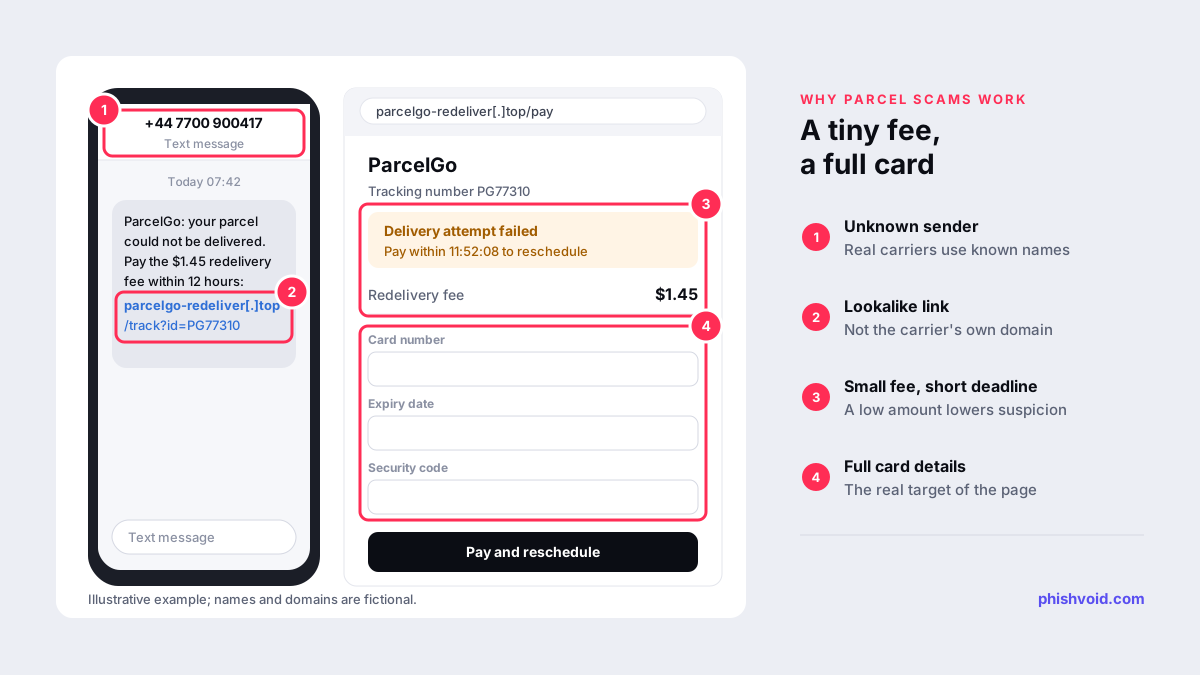
A parcel scam does not need a target list. At any moment, a large share of the people who receive a "delivery failed" text really are waiting for something, so the message fits their day. Several features of the sector make it easy to exploit:
- Small, believable payments. A redelivery charge or a customs fee sounds routine. The amount is low on purpose; the real goal is the full card details and the one-time code that follows.
- Simple pages to clone. A tracking page is a logo, a search box and a status bar. A kit can copy it in minutes and swap the brand.
- Many parties per shipment. Retailer, carrier, local partner and customs authority may all send messages, so customers rarely know who should contact them.
- Trust between businesses. Shippers and brokers book loads, confirm rates and change payment details by email, often under time pressure.
The result is a brand that gets impersonated in front of consumers, job seekers and business partners at the same time, through SMS, email, search, social media and job boards.
The impersonation formats to monitor
Fake tracking and redelivery pages
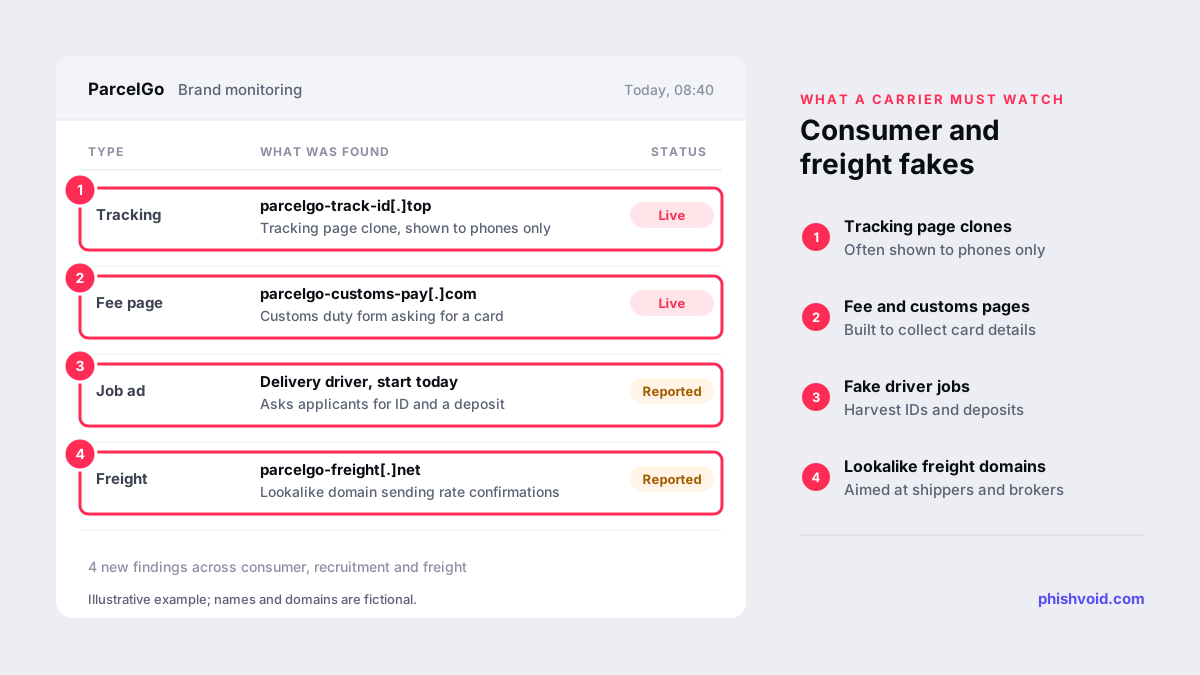
The most common format: a text or email with a tracking link that opens a cloned page on a lookalike domain. Many of these pages show their content only to mobile visitors from one country and send everyone else to the real site, a technique known as cloaking. That matters for evidence, as we explain below.
Customs and duty fee pages
Fake customs pages borrow the carrier's name and the authority of a tax office at once. Our guide to the customs fee scam text shows how real duty bills are presented in several countries, which helps when you write your own customer guidance.
Fake courier websites used in other scams
Some fraudsters build a whole fake shipping company, or copy yours, to support a different scam: a buyer of a pet, a car or a phone is sent a tracking link showing the item "in transit" and then asked for insurance or clearance fees. These sites can run for weeks because the victims are not your customers and rarely contact you.
Freight and B2B impersonation
On the business side, lookalike email domains are used to send fake rate confirmations, booking confirmations and invoices with changed bank details, the same pattern seen in invoice fraud. In US trucking, identities of legitimate carriers and brokers are also stolen; the FMCSA keeps a page on broker and carrier fraud and identity theft with its reporting channels.
Fake driver and warehouse jobs
Courier, driver and warehouse roles are easy to advertise and attract many applicants. In the same Q2 2026 report, Crane Authentication noted a growing volume of job scams in which recruiters and their companies are impersonated. Our guide on recruitment fraud impersonating a company covers the response.
Building the monitoring layer
Monitoring for a logistics brand has to look where each of these formats appears, not only at new domains.
- Domains and certificates. Watch new registrations and certificate transparency logs for your brand combined with words such as track, delivery, redelivery, parcel, customs, pay and freight, in every country-code domain where you operate. Our lookalike domain monitoring guide explains the sources.
- SMS sender names. Where a sender ID scheme exists, register the names you use. In the UK, the Mobile Ecosystem Forum runs an SMS SenderID Protection Registry that blocks registered sender names when they are used by anyone else.
- Customer reports. Give customers one address or form for suspicious messages, and ask support agents to tag tickets about fake delivery texts so you can count them.
- Job boards and social media. Search for driver and courier vacancies using your name, and for accounts posing as your support team.
- Partners. Retailers, marketplaces and freight customers often see fakes first. Tell them where to forward them.
Taking down fake tracking and fee pages
The removal route is the same as for other phishing sites, with a few logistics-specific details.
- Capture evidence the way victims see it. Open the link with a mobile user agent and, if needed, from the country the texts target. Save the full URL, screenshots, the payment form and the original message.
- Get browser warnings first. Report the URL to Google Safe Browsing and Microsoft SmartScreen, so phones and browsers warn visitors while removal is pending.
- Report to the host, registrar and CDN in parallel. Our takedown process guide lists what each one needs.
- Treat it as a campaign. Parcel kits rotate through many domains. Link new sites to earlier ones and report the pattern, not just the single URL.
Phishvoid handles this as a managed service: a human team verifies each fake tracking or fee page, reports it to blocklists, hosts, CDNs and registrars (and to USOM for sites targeting Türkiye), and follows up until it is down.
Making the real delivery experience easy to recognize
Takedowns shorten each campaign; clear genuine channels make the next one less effective.
- Publish one page listing the domains, short links and SMS sender names you use, and say plainly whether you ever request fees by text.
- Keep tracking links on your main domain rather than new campaign domains or generic link shorteners.
- Enforce DMARC on all your domains, including parked ones that never send mail. It will not stop lookalike domains, but it blocks exact spoofing of yours.
- Brief support agents and drivers on what the current fakes look like and what to tell customers who paid.
- For freight customers, state that bank detail changes are never confirmed by email alone and give a known phone number for checks.
Who owns it, and what to measure
Brand protection in logistics usually sits with security or fraud, but it depends on customer service, communications, HR for job scams and sales operations for freight. Name one owner and agree who confirms whether a domain or account is genuine. Useful measures are the time from first report to blocklisting, the time to removal, the number of repeat campaigns and the volume of support tickets about fake delivery messages. A falling ticket count is often the clearest sign that the program is working.
FAQ
Can a logistics company stop scammers sending fake delivery texts?
Not entirely, because the texts are sent from numbers and services the company does not control. It can register sender names where a scheme exists, report abusive numbers and, most importantly, take down the landing pages where the harm happens.
Who removes a fake tracking page?
The hosting provider removes the content, the registrar can suspend the domain and a CDN can stop serving it. Browser blocklists do not remove the page, but they warn visitors, which protects most potential victims while removal is pending.
Do freight forwarders and brokers need brand protection too?
Yes. Their risk is less about mass texts and more about lookalike email domains, cloned company websites and stolen identities used to divert loads or payments. Monitoring and takedown of lookalike domains covers much of it.
Should we warn customers about a specific fake site?
Usually it is better to describe the pattern, such as texts asking for a redelivery fee, and point to your official channels. Publishing a live domain can send curious people to it. Warn about specific sites only when it helps people who may already have used them.
Is someone impersonating your brand?
We find lookalike domains and cloned pages and take them down. Start with a free exposure scan.