A fake giveaway scam says you won, then asks for a fee, card details or a code. Learn how to check a giveaway, what to do if you replied and where to report.
Quick answer: A fake giveaway scam tells you that you have won a prize from a brand, creator or celebrity, then asks you to pay a fee, enter card details, share a login code or send crypto to claim it. The simplest test is money: real prizes are free, and the US Federal Trade Commission says that paying for "taxes", shipping or processing to collect a prize is a sign of a scam (FTC).
This guide covers the versions you are most likely to meet on social media, how to check whether a giveaway is real, what to do if you already responded, and how brands can respond when scammers run giveaways in their name.
How fake giveaway scams work
Almost every version follows the same three steps: borrow trust from a real name, create a winner, then charge the winner. The details vary.
The "you won" message from a copycat account
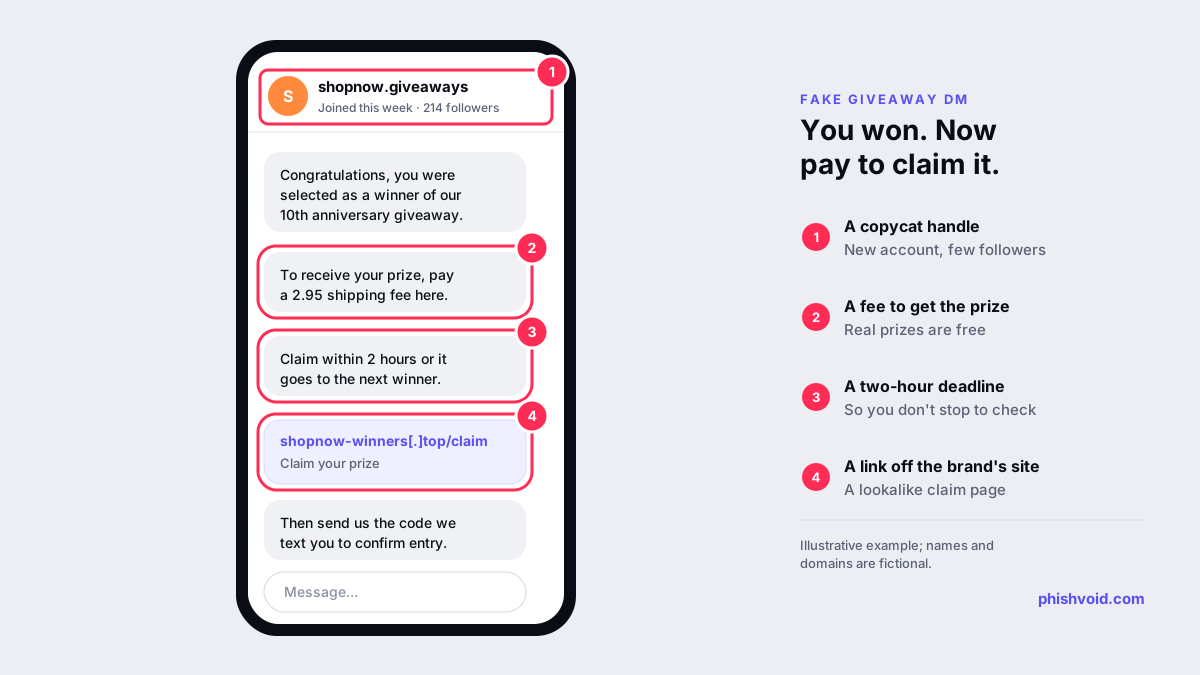
A brand runs a real giveaway on social media. Within hours, accounts with almost the same handle, such as shopnow.giveaways or shopnow_official.winners, reply to people who commented or message them directly: "Congratulations, you were selected." The account uses the real logo and copies real posts, so it looks official at a glance.
The claim page with a small fee
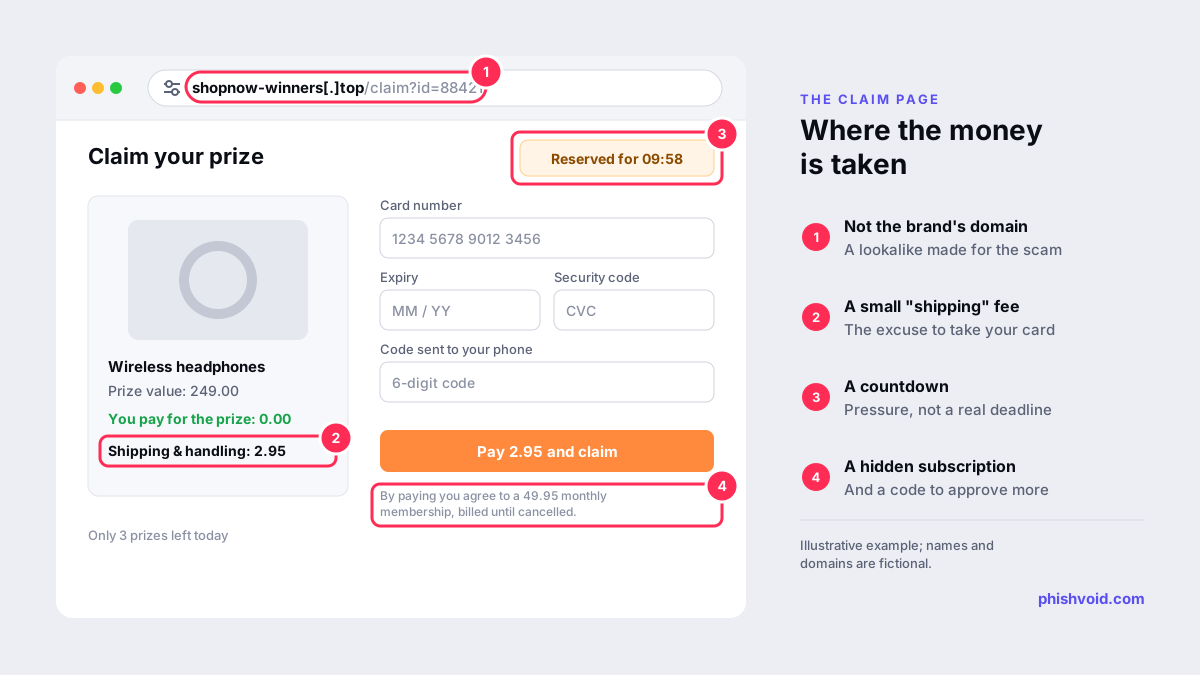
The message links to a page where you "confirm your prize" by paying a small shipping or handling charge. The fee is a pretext. The page collects your full card details, and some ask for the code your bank sends, which can be used to approve a different, larger payment. Meta describes the same pattern in its lottery scam guidance: a small upfront payment, followed by requests for your address or bank details to "verify your identity" (Facebook Help).
The crypto "send one, get two back" giveaway
A video, livestream or post appears to show a famous founder or company promising to double any cryptocurrency sent to a wallet address. The FTC is blunt about this one: free money promises are always fake, and crypto sent to such an address goes straight to a scammer (FTC). Crypto payments are very hard to reverse.
The survey or spin-the-wheel page
An ad or forwarded message promises a gift card or new phone for answering a few questions. Every visitor "wins". The prize page then asks for personal details, a card number for a small fee, or signs you up to a costly subscription in the small print.
The account takeover giveaway
The "organizer" asks you to log in to a voting page or to send them a code you just received by SMS to "confirm your entry". That code is often a password reset or login code for your own account. Once they have it, your account is used to run the same scam on your followers. This is why a code should never be shared with anyone, whatever the reason given.
How to tell a real giveaway from a fake
Real giveaways can be checked. Before you reply or click, run through these points:
- You never pay to win. Not for shipping, taxes, insurance or "verification". Real sweepstakes are free and decided by chance (FTC).
- Check the handle, not the name or logo. Open the profile. Compare the exact handle, the follower count, the account age and the post history with the brand's official account, which you can find from its website.
- Find the giveaway on the official account. If the brand did not post it, it does not exist. If it did, the official rules will say how winners are chosen and contacted.
- Check where the link goes. A claim page should be on the brand's own domain. Lookalike domains such as
shopnow-winners[.]topor a free website builder are warning signs. - Watch for pressure. "Claim within 2 hours or the prize goes to the next winner" is designed to stop you checking.
- Never share codes or passwords. No giveaway needs your login, a one-time code or a crypto recovery phrase.
When in doubt, contact the brand through its website or app, not through the account that messaged you, and ask whether the giveaway is genuine. For a broader set of checks, see is this a scam?
If you already responded
Move quickly; what helps most depends on what you shared.
- You entered card details or paid a fee: call the number on the back of your card, report the payment as fraud and ask for the card to be blocked. Watch for repeated small charges, which can signal a subscription trap.
- You shared a login code or password: change the password through the official app or site, sign out other sessions, and turn on multi-factor authentication. If you lost access, use the platform's official account recovery.
- You sent crypto: report it to the exchange you used straight away, with the wallet address and transaction ID. In the US, also report to the FBI's IC3. Be wary of anyone who then offers to recover the funds for a fee.
- You shared ID or personal details: expect follow-up phishing that uses them. In the US, IdentityTheft.gov has recovery steps.
Our I got phished page has a fuller recovery checklist.
Where to report a fake giveaway
- On the platform: report the account or post as a scam or impersonation using the report option on the profile or message. Instagram and Facebook both list advance-fee prize offers as a common scam pattern.
- The claim website: report it to Google Safe Browsing so browsers warn other people, or report it to us and our analysts will verify it and pursue removal with the host.
- In the US: report the scam to the FTC at ReportFraud.ftc.gov.
- In England, Wales and Northern Ireland: report fraud to Report Fraud, the service that replaced Action Fraud.
Elsewhere, our guide on how to report a scam lists the right agency by country.
For brands: when scammers run giveaways in your name
Fake giveaways hurt the brand they copy. Customers lose money, blame the company, and become wary of genuine promotions. A few steps reduce the damage:
- Publish rules on your own domain. Every genuine giveaway should link to official terms on your website that state how winners are contacted and that you never charge a fee.
- Warn in the post itself. Pin a short note: "We will only contact winners from this account. We never ask for payment or codes."
- Watch the comments during a campaign. Copycat accounts move fastest while the post is active, so check replies and report impersonators as they appear. Our guides on Instagram impersonation reports and fake Facebook Pages cover the business routes.
- Remove the claim sites, not just the accounts. Accounts are cheap to replace; the phishing pages behind them collect the data. Reporting those domains to hosts, registrars and blocklists cuts off the payoff.
Phishvoid monitors for social media impersonation and lookalike domains, verifies each find by hand and handles the takedown reports, under one subscription with unlimited takedowns.
FAQ
Do you have to pay to claim a real giveaway prize?
No. Real prizes are free. A request to pay for shipping, taxes, insurance or processing before you receive a prize is one of the clearest signs of a scam.
How can I check if a giveaway account is real?
Go to the brand's website, follow its link to the official social account, and compare the exact handle. Then check whether the giveaway appears on that official account. Copycats often have similar names, few posts and recent creation dates.
Why do scammers comment "you won" under real giveaway posts?
Because people who entered a real giveaway are expecting to hear back. Replying under the genuine post makes the fake account look connected to it.
Are crypto giveaways from celebrities ever real?
Not the kind that asks you to send crypto first. The FTC says promises to multiply cryptocurrency you send are scams, and the money usually cannot be recovered.
What if I only clicked the link but entered nothing?
The risk is usually low. Close the page, do not return to it, keep your browser and device updated, and report the account and link. If your device asked to install anything, do not allow it.
Is someone impersonating your brand?
We find lookalike domains and cloned pages and take them down. Start with a free exposure scan.